

Regulatory Signs: The Road Signs You Must Obey
Regulatory signs tell you what traffic laws require, like STOP, YIELD, speed limits and DO NOT ENTER. Learn their shapes, colors, codes and meaning.
Bianca Galvan
Product & Content at GetMyPermit
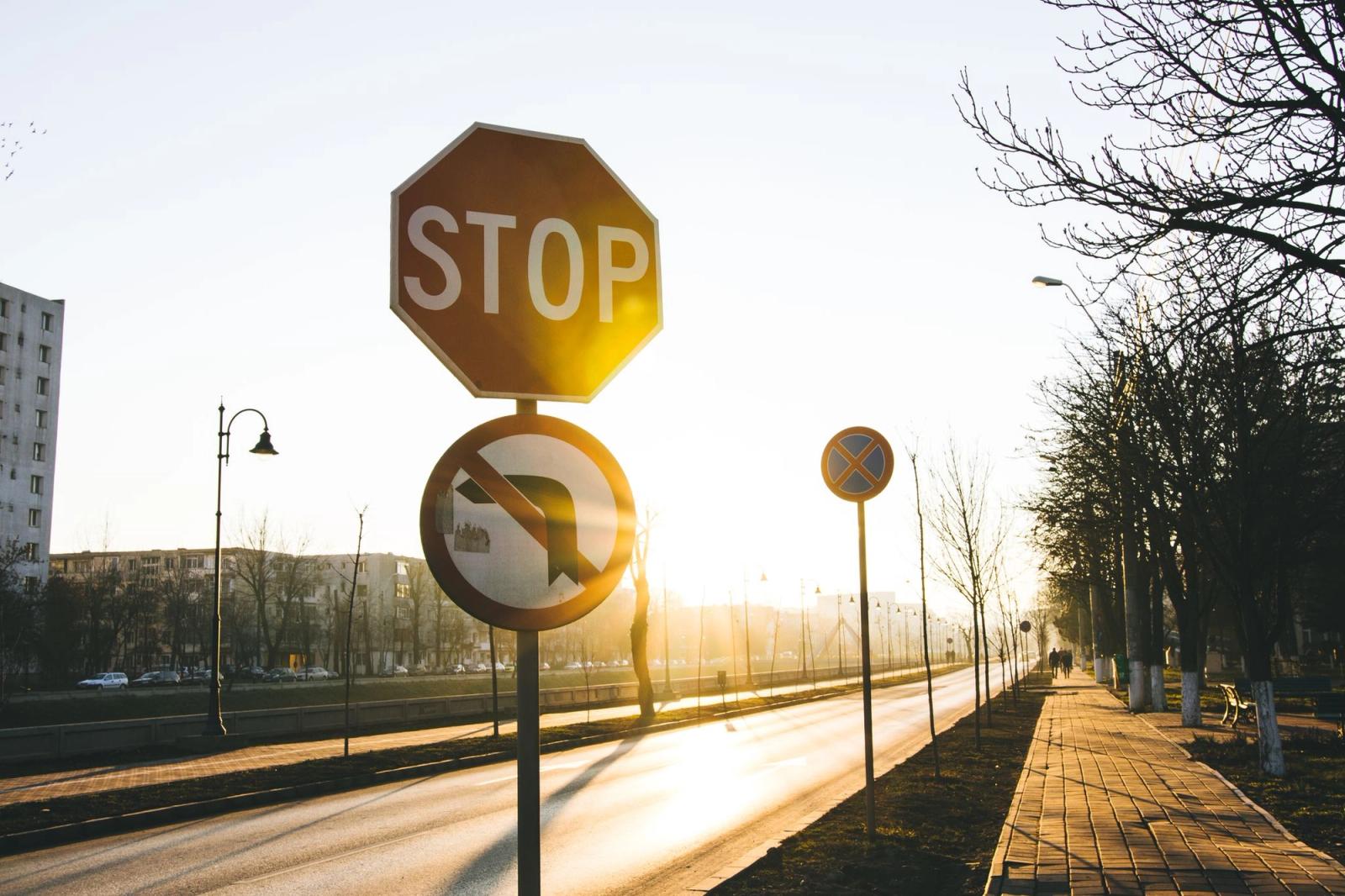
Regulatory signs are the road signs that tell you what the law requires you to do or not do, like STOP, YIELD, SPEED LIMIT, DO NOT ENTER and ONE WAY. Most are white rectangles with black letters, and a few use red. Unlike warning and guide signs, ignoring one means breaking a traffic law.
Their design is set by the federal Manual on Uniform Traffic Control Devices (MUTCD), 11th Edition, Chapter 2B, "Regulatory Signs, Barricades, and Gates." The current version includes Revision 1 (December 2025), and the Chapter 2B section numbers below are the same in both. For a tour of every sign type, see our guide to road sign meanings.
What are regulatory signs?
The MUTCD defines them in one line (Section 2A.03): "Regulatory signs give notice of traffic laws or regulations." Section 2B.01 adds that they must be installed at or near where the regulation applies, and must be retroreflective or lit so you can read them at night.
Pennsylvania's driver manual says it plainly: "Regulatory signs tell you what you must do, or must not do, according to the law."
The sign itself is not the law. The rule comes from a state law, local ordinance or regulation, and the sign tells you it applies here. Section 2B.21, for example, says a Speed Limit sign shows the limit "established by law, ordinance, regulation, or as adopted by the authorized agency based on an engineering study."
How are regulatory signs different from warning and guide signs?
The MUTCD gives each sign family a different job (Section 2A.03) and its own look:
- Regulatory signs give notice of traffic laws. Section 2B.02 says they "shall be rectangular unless specifically designated otherwise."
- Warning signs give notice of "a situation that might not be readily apparent," like a curve or merge. Most are diamonds with a black legend on yellow (Section 2C.02). See our guide to warning signs.
- Guide signs show routes, destinations, directions and distances. They usually have a white message and border on green (Section 2D.02).
The MUTCD color code (Section 1D.05) backs this up. White and black mean "regulation," red means "stop or prohibition," yellow means "warning," and green means permitted movements and direction guidance. So: a white sign states a rule, a yellow sign warns you, and a green sign guides you.
What shapes and colors do regulatory signs use?
Pennsylvania's manual describes three looks:
- Black and white rectangles or squares, like SPEED LIMIT. This is the most common.
- Black, white and red, with a red circle and slash, like NO LEFT TURN. California's handbook says the picture inside the circle "shows what you cannot do."
- Red and white, like STOP, YIELD, DO NOT ENTER and WRONG WAY.
Some regulatory signs have shapes no other sign may use (Table 2A-1):
- Octagon: only the STOP sign (R1-1).
- Downward-pointing triangle: only the YIELD sign (R1-2).
- Crossbuck (X shape): only the railroad Grade Crossing sign (R15-1). See our guide to railroad crossing signs.
What do the "R" codes on regulatory signs mean?
Every regulatory sign in the MUTCD has a code that starts with R. The number groups signs that do similar jobs. Going by the section titles in Chapter 2B:
- R1: STOP and YIELD
- R2: speed limits
- R3: turn prohibitions and lane use
- R4: passing and keep right
- R5: DO NOT ENTER, WRONG WAY and exclusions like No Trucks
- R6: ONE WAY
- R7 and R8: parking, standing and stopping
- R10: traffic signal signs, like NO TURN ON RED
Codes ending in P are plaques, the smaller signs mounted with a main sign. You won't need the codes on your permit test, but they make the MUTCD easy to search.
What are the main groups of regulatory signs?
STOP sign (R1-1) and ALL-WAY plaque (R1-3P)
Section 2B.04 says a STOP sign is used when "a full stop is always required" on an approach to an intersection. No extra words are allowed on its face. When every approach has a STOP sign, an ALL-WAY (R1-3P) plaque goes under each one, with white letters on red. Plaques that say 2-WAY, 3-WAY or 4-WAY "shall not be used with STOP signs."
What to do: Pennsylvania says to "stop completely," and that "slowing down without coming to a full stop is illegal." If there's a crosswalk or stop line, stop before the front of your vehicle reaches the first painted line. California adds that if there's no limit line or crosswalk, you stop before entering the intersection.
At an all-way stop, Pennsylvania says the first vehicle to arrive goes first. If two arrive together, the driver on the left yields to the driver on the right. More in our right of way rules guide.
YIELD sign (R1-2)
Section 2B.05 says the YIELD sign requires you to give the right-of-way to other traffic. You slow to a reasonable speed, or stop when needed, so you don't interfere with conflicting traffic. Our yield sign guide covers it in detail.
Speed Limit sign (R2-1)
Section 2B.21 says speed limits are shown in multiples of 5 mph, and signs go where the limit changes. Related R2 signs:
- Night Speed Limit (R2-3P): where day and night limits differ, both must be posted (Section 2B.23).
- Minimum Speed Limit (R2-4P): only used under a Speed Limit sign (Section 2B.24).
- BEGIN and END HIGHER FINES ZONE (R2-10 and R2-11): mark a zone with higher fines for violations (Section 2B.25).
Don't confuse a speed limit with an advisory speed. The small yellow plaque under a curve sign is a warning, and Section 2B.21 says a Speed Limit sign should not be used for that purpose. Pennsylvania calls the posted limit "the maximum legal speed under ideal conditions," so drive slower when conditions are poor. See our guide to speed limit and advisory speed signs.
Turn prohibition signs (R3-1 to R3-4, R3-18 and R3-27)
Section 2B.26 calls these Movement Prohibition signs: No Right Turn (R3-1), No Left Turn (R3-2), NO TURNS (R3-3), No U-Turn (R3-4), No U or Left Turn (R3-18) and No Straight Through (R3-27).
They ban a move from the whole approach, not just one lane. Some apply only at certain hours, so check for times on the sign or a plaque. Section 2B.26 also lets No Left Turn and No Right Turn signs be left out where ONE WAY signs are used, so a ONE WAY sign may be the only clue about which turn is off-limits.
Lane use signs (R3-5 to R3-9 series)
These signs show which moves are allowed from each lane (Sections 2B.27 to 2B.32):
- Mandatory Movement signs (R3-5 and R3-7) show the single move required from the lane, with the word ONLY. Pennsylvania says you must make the turn, "even if you are in the turn-only lane in error."
- Optional Movement signs (R3-6) show two or more allowed moves, like straight or right. They never say ONLY.
- Advance Intersection Lane Control signs (R3-8) are posted before the intersection.
- Two-Way Left-Turn-Only signs (R3-9a and R3-9b) mark a center lane for left turns in both directions, not for passing or through travel.
Passing and keep right signs (R4 series)
- DO NOT PASS (R4-1) may back up no-passing pavement markings, and PASS WITH CARE (R4-2) marks the end of the zone (Sections 2B.36 and 2B.37).
- KEEP RIGHT EXCEPT TO PASS (R4-16) and SLOWER TRAFFIC KEEP RIGHT (R4-3) tell you to stay in the right lane unless you're passing, or to keep right if you're driving slower than traffic (Section 2B.38).
- Keep Right (R4-7) means you must pass only to the right of an island or obstruction (Section 2B.39).
DO NOT ENTER (R5-1) and WRONG WAY (R5-1a)
Section 2B.46 requires a DO NOT ENTER sign where a two-way road becomes one-way, where an interchange exit ramp meets a crossroad, and at other entry points to one-way roads. The WRONG WAY sign is an extra layer: Section 2B.47 places it farther along the one-way road than the DO NOT ENTER sign. Pennsylvania says the two "work as a team." See our Do Not Enter sign guide.
If you do enter the wrong way, California says: "When it is safe, back out or turn around." At night, road reflectors shining red in your headlights mean you're going the wrong way.
ONE WAY signs (R6-1 and R6-2)
Section 2B.49 says ONE WAY signs mark roads where traffic may travel in one direction only. They're placed at every alley and road that meets the one-way street. Travel only in the direction the arrow points.
Exclusion signs (R5 series)
Section 2B.45 calls these Selective Exclusion signs. They show that state or local laws keep certain traffic off a road, like No Trucks (R5-2), No Bicycles (R5-6) or NO THRU TRAFFIC (R5-12).
Parking, standing and stopping signs (R7 and R8 series)
Section 2B.53 uses color to separate them:
- Prohibitive parking signs have a red legend and border on white.
- Permissive parking signs (time-limited parking, or parking a certain way) have a green legend and border on white.
Section 2B.52 defines two words that show up on permit tests. "Standing" means keeping the vehicle stationary while you stay in it. "Stopping" covers any vehicle, with or without a driver, that stops for a reason other than avoiding traffic or following official directions.
NO TURN ON RED (R10-11 series)
Section 2B.60 requires a NO TURN ON RED sign wherever a turn on a red light is prohibited. Some versions apply only at certain hours or to certain lanes. Pennsylvania says you must wait for the green light. For the full rules, see can you turn right on red.
What do you have to do when you see a regulatory sign?
Obey it. California's handbook says white rectangular signs communicate "many important rules you must obey." Pennsylvania warns that ignoring regulatory signs can get you fined and points on your driving record, because you are breaking the law.
A few habits help:
- Read the plaques. Times, days, vehicle types and exceptions change who the rule applies to.
- Watch where rules start and end. BEGIN and END plaques (R3-9cP and R3-9dP) can mark the limits (Section 2B.33).
- Pick your lane early. An ONLY lane commits you to that move.
- Treat the speed limit as a maximum, not a target.
How do regulatory signs show up on the permit test?
Pennsylvania notes that most signs in each category "have a special shape and color," and that's how permit tests usually ask about them: you see a shape or color and pick its meaning. If you're testing in Pennsylvania or California, the handbooks cited here are a good place to start.
A quick cheat sheet:
- Octagon: STOP, come to a full stop
- Downward triangle: YIELD, give the right-of-way
- White rectangle: a rule you must obey
- Red circle with a slash: the action shown is not allowed
- Red on white parking sign: no parking
- Green on white parking sign: parking allowed, with limits
- Arrow with ONLY: you must make that move from this lane
Then test yourself with real sign questions on our free permit practice test.
Sources
- MUTCD 11th Edition with Revision 1, Chapter 2B: Regulatory Signs, Barricades, and Gates (FHWA)
- MUTCD 11th Edition, Chapter 2B: Regulatory Signs, Barricades, and Gates, December 2023 (FHWA)
- MUTCD 11th Edition with Revision 1, Chapter 2A: General (FHWA)
- MUTCD 11th Edition with Revision 1, Chapter 2C: Warning Signs and Object Markers (FHWA)
- MUTCD 11th Edition with Revision 1, Chapter 2D: Guide Signs for Conventional Roads (FHWA)
- MUTCD 11th Edition with Revision 1, Part 1: General (FHWA)
- 11th Edition of the MUTCD with Revision 1 (FHWA)
- Pennsylvania Driver's Manual, PUB 95 (PennDOT)
- California Driver Handbook, Section 7: Laws and Rules of the Road (California DMV)
Free permit practice test for your state
Ready to check what you know? Take a free 10-question test from your state's driver handbook, with every answer explained. No sign-up needed. See questions and pass marks for every state.
- Alabama
- Alaska
- Arizona
- Arkansas
- California
- Colorado
- Connecticut
- Delaware
- Florida
- Georgia
- Hawaii
- Idaho
- Illinois
- Indiana
- Iowa
- Kansas
- Kentucky
- Louisiana
- Maine
- Maryland
- Massachusetts
- Michigan
- Minnesota
- Mississippi
- Missouri
- Montana
- Nebraska
- Nevada
- New Hampshire
- New Jersey
- New Mexico
- New York
- North Carolina
- North Dakota
- Ohio
- Oklahoma
- Oregon
- Pennsylvania
- Rhode Island
- South Carolina
- South Dakota
- Tennessee
- Texas
- Utah
- Vermont
- Virginia
- Washington
- West Virginia
- Wisconsin
- Wyoming