

Yield Sign: What It Means and What to Do
A yield sign (MUTCD R1-2) means slow down, be ready to stop, and let traffic and pedestrians with the right-of-way go first. Here's what to do.
Bianca Galvan
Product & Content at GetMyPermit
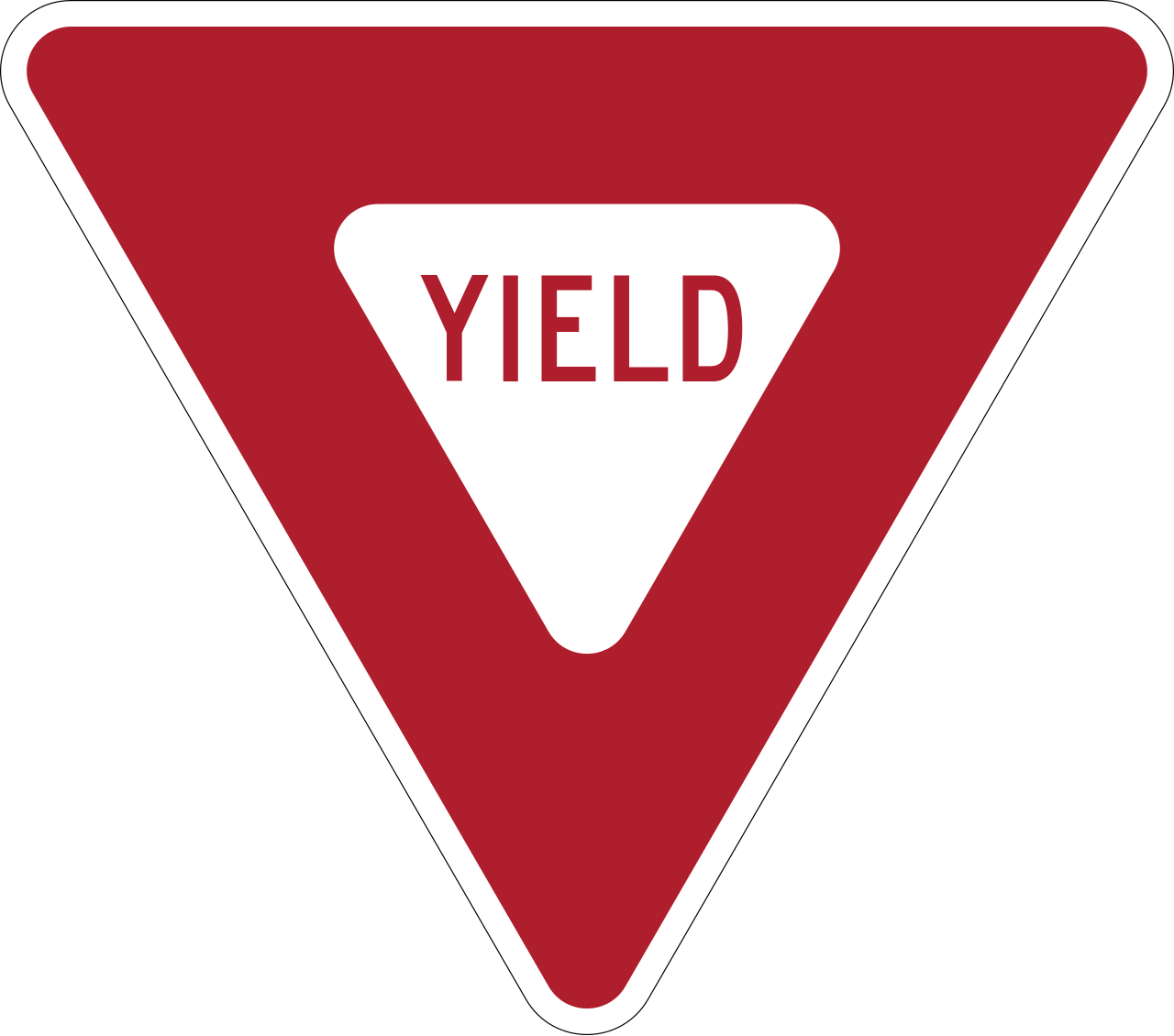
A yield sign means you must slow down, be ready to stop, and let other vehicles, bicyclists, and pedestrians go first before you continue. It's the red-and-white triangle that points down, and its official code is R1-2. You only have to stop if someone with the right-of-way is coming or crossing.
The sign looks the same in every state because US traffic signs follow the federal Manual on Uniform Traffic Control Devices (MUTCD).
What does a yield sign look like?
A yield sign is an equilateral triangle pointing down, with a wide red border, a white center, and the word YIELD in red letters (MUTCD Section 2B.05, Figure 2B-1). New York's driver's manual describes it as "Red and white, with red letters."
The shape is reserved for this one sign. MUTCD Table 2A-1 (Section 2A.05) limits the downward-pointing triangle exclusively to the YIELD sign, and the YIELD sign must always use that shape. Georgia's manual sums it up: "Triangle signs mean yield."
Size depends on the road. Table 2B-1 sets 36 inches per side on single-lane roads, 48 inches on multi-lane roads and expressways, and 60 inches on freeways. A 30-inch size is allowed on some low-speed roads.
What does the MUTCD code R1-2 mean?
R1-2 is listed with the regulatory signs in MUTCD Chapter 2B, the signs that tell you about traffic laws. The STOP sign next to it is R1-1.
Because it's a regulatory sign, ignoring it is breaking the law. Pennsylvania's manual warns that disobeying regulatory signs can mean a fine and points on your driving record.
A plaque under the sign may tell you who to yield to (Section 2B.18):
- TO ONCOMING TRAFFIC (R1-2aP): used where you must yield to traffic from the opposite direction, such as at a one-lane bridge.
- TO TRAFFIC IN CIRCLE (R1-2bP) or TO ALL LANES (R1-2cP): used at multi-lane roundabouts.
What do you have to do at a yield sign?
The MUTCD says the YIELD sign requires you to give the right-of-way to other traffic. You need to slow to a speed that's reasonable for conditions, or stop when necessary so you don't interfere with conflicting traffic (Section 2B.05).
State handbooks put it simply:
- California: "Slow down and be ready to stop to let any vehicle, bicyclist, or pedestrian pass before you proceed."
- Pennsylvania: "When you see this sign, you must slow down and check for traffic and give the right-of-way to pedestrians and approaching cross traffic. You stop only when it is necessary."
- New York: "You must come to a full stop at a YIELD sign if traffic conditions require it."
In practice, that means:
- Slow down as you approach.
- Look for cars, bicyclists, and pedestrians with the right-of-way.
- If someone is coming or crossing, stop and wait.
- Go only when you have a big enough gap. Pennsylvania's manual says you need "a sufficient gap in traffic" before you continue.
The key difference from a STOP sign: a STOP sign is used where a full stop is always required (MUTCD Section 2B.04). At a yield sign, you stop only when you need to. And if you do, Oregon's manual says to stop "the same as you would for a stop sign." For more on who goes first, see our guide to right-of-way rules.
Where do you stop at a yield sign?
Some yield signs come with a yield line painted on the road. Under MUTCD Section 3B.19, a yield line is a row of solid white triangles that extends across the lane and points toward you. It marks the point where you're supposed to yield. Each triangle is 12 to 24 inches wide at the base. If you need to stop, stop behind that line.
Pennsylvania's manual describes these as "white triangles painted across the lane to indicate you must yield to approaching traffic." Yield lines are only used with a sign that tells you to yield, never at a STOP sign or a traffic signal (Section 3B.19).
If there's a marked crosswalk, the yield sign is normally placed before the crosswalk, except at roundabouts and channelized right-turn lanes (Section 2B.18). Pedestrians have the right-of-way in marked or unmarked crosswalks, as California's handbook points out.
What is the Yield Ahead sign (W3-2)?
The Yield Ahead sign (W3-2) is a yellow diamond with a red-and-white yield triangle and a black arrow (MUTCD Figure 2C-8). It's a warning sign, so it uses the yellow diamond shape (Section 2C.02).
It must be installed when the yield sign isn't visible from far enough away for drivers to react, for example because of a curve. It can also be used for extra emphasis (Section 2C.35). When you see it, start slowing down and get ready to yield.
What are "Yield Here to Pedestrians" signs?
The Yield Here to Pedestrians sign (R1-5) is a white square sign with a small yield triangle, the word HERE, an arrow, and a pedestrian symbol (MUTCD Figure 2B-2). It's used where a marked crosswalk crosses a multi-lane road with no signal or STOP sign, and where yield lines are painted ahead of the crosswalk. It's placed 20 to 50 feet before the crosswalk (Section 2B.19).
Stopping back there keeps your car from blocking other drivers' view of the pedestrian, and the pedestrian's view of cars in the next lane (Section 2B.19).
There are related versions for school crossings (R1-5a) and trail crossings (R1-5d). The Stop Here for Pedestrians sign (R1-5b) is used only where state law requires drivers to stop for pedestrians in a crosswalk.
Where are yield signs used?
The MUTCD lists several places where yield signs fit (Sections 2B.05, 2B.10, and 2B.18):
- Roundabouts: on the approaches. California's handbook says to "Yield to all traffic already in the roundabout."
- Merges: where an entering road lacks the acceleration space or sight distance for a smooth merge. Pennsylvania's manual says entering traffic "must yield to traffic already on the major roadway."
- Right-turn lanes separated by an island: even when the main intersection has a signal or STOP sign.
- One-lane bridges and underpasses: where two-way traffic narrows to one lane.
- Quiet intersections: where a full stop isn't needed every time, such as two local streets.
How does the yield sign show up on the permit test?
On the written test, you should be able to identify the yield sign by its shape alone and know what it asks of you: slow down, give the right-of-way, and stop only if needed.
Brush up on other shapes and colors with our guide to road sign meanings, then test yourself with a permit practice test.
Sources
- FHWA: MUTCD 11th Edition, Chapter 2A, Section 2A.05 Shapes and Table 2A-1 Use of Sign Shapes (PDF)
- FHWA: MUTCD 11th Edition, Chapter 2B, Sections 2B.03, 2B.04, 2B.05 YIELD Sign (R1-2), 2B.10 Yield Control, 2B.18 STOP Sign or YIELD Sign Placement, and 2B.19 Yield Here to Pedestrians Signs (PDF)
- FHWA: MUTCD 11th Edition, Chapter 2C, Sections 2C.02 Design of Warning Signs and 2C.35 Advance Traffic Control Signs (W3-2) (PDF)
- FHWA: MUTCD 11th Edition, Part 3, Section 3B.19 Stop and Yield Lines (PDF)
- California Driver's Handbook: Section 7, Laws and Rules of the Road
- Pennsylvania Driver's Manual, Chapter 2: Signals, Signs and Pavement Markings (PDF)
- Chapter 4: Traffic Control | NY DMV
- Georgia Department of Driver Services: Driver's Manual, Section 7 Continued
- Oregon Driver Manual: Signs and Traffic Signals
Free permit practice test for your state
Ready to check what you know? Take a free 10-question test from your state's driver handbook, with every answer explained. No sign-up needed. See questions and pass marks for every state.
- Alabama
- Alaska
- Arizona
- Arkansas
- California
- Colorado
- Connecticut
- Delaware
- Florida
- Georgia
- Hawaii
- Idaho
- Illinois
- Indiana
- Iowa
- Kansas
- Kentucky
- Louisiana
- Maine
- Maryland
- Massachusetts
- Michigan
- Minnesota
- Mississippi
- Missouri
- Montana
- Nebraska
- Nevada
- New Hampshire
- New Jersey
- New Mexico
- New York
- North Carolina
- North Dakota
- Ohio
- Oklahoma
- Oregon
- Pennsylvania
- Rhode Island
- South Carolina
- South Dakota
- Tennessee
- Texas
- Utah
- Vermont
- Virginia
- Washington
- West Virginia
- Wisconsin
- Wyoming