

Speed Limit Signs: Regular and Advisory Limits Explained
A white Speed Limit sign is the legal maximum. A yellow advisory speed sign is the recommended safe speed for a curve or hazard. Here's how they differ.
Bianca Galvan
Product & Content at GetMyPermit
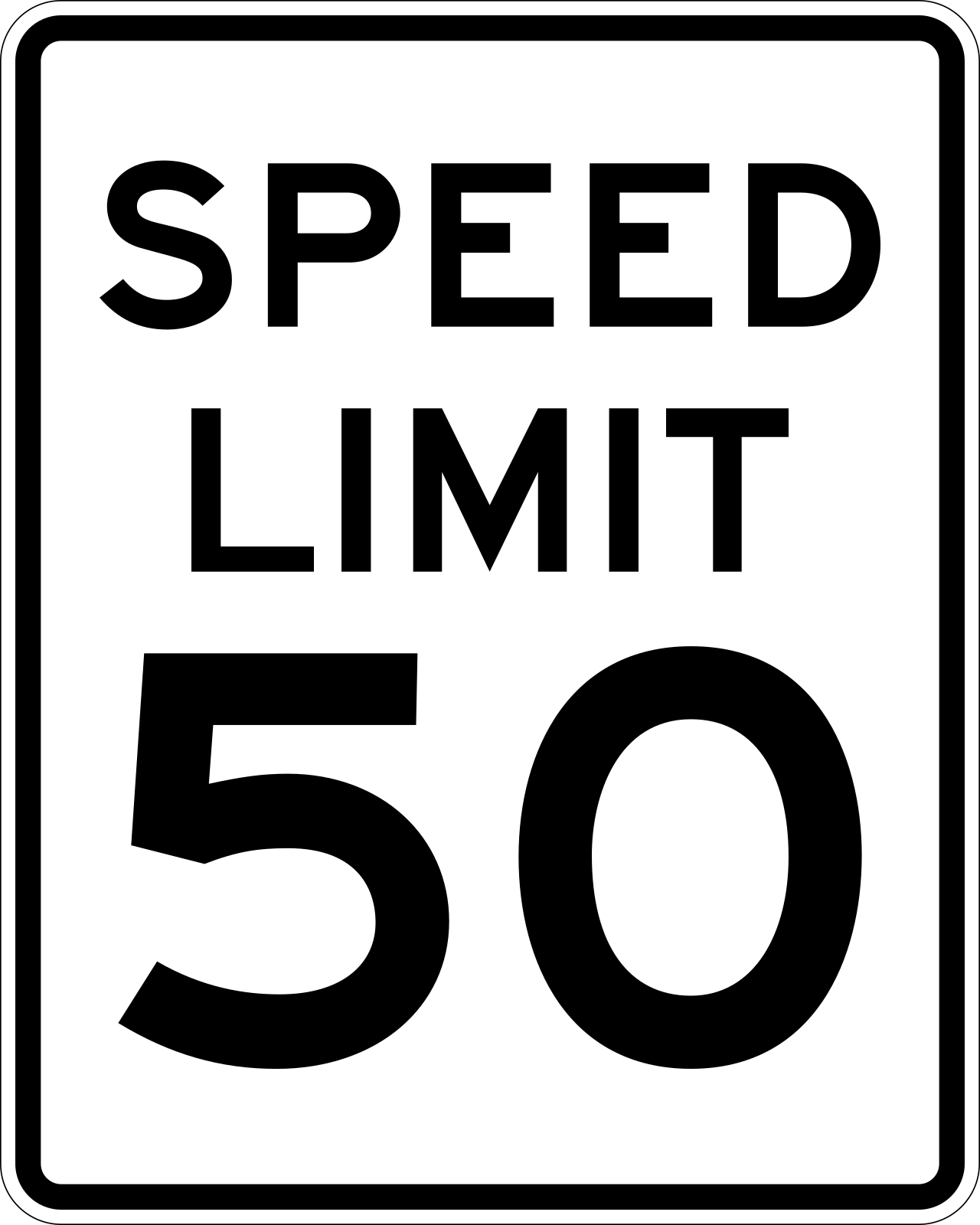
A white rectangular Speed Limit sign shows the legal maximum speed for that stretch of road, and you must obey it. A yellow advisory speed sign (a small plaque with a number and "MPH" under a warning sign) shows the speed recommended for a curve or hazard ahead. One is a law, the other is a safety recommendation, and on the permit test you need to know both.
Both signs come from the Manual on Uniform Traffic Control Devices (MUTCD), the federal standard that sets how traffic signs look and are used across the US. Below are the main speed signs you'll see, what each means, and what to do.
What does a regular Speed Limit sign mean?
The Speed Limit sign (MUTCD code R2-1) is a regulatory sign. The MUTCD says regulatory signs "give notice of traffic laws or regulations." Most regulatory signs are rectangles, and they use a white background with a black legend, so the Speed Limit sign is a white rectangle with black text.
According to the MUTCD, the number on the sign is the limit set by law, ordinance or regulation, or by the agency in charge of the road after an engineering study. A few details worth knowing:
- Always a multiple of 5. The MUTCD requires posted speed limits to be in multiples of 5 mph (25, 30, 35 and so on).
- Posted where the limit changes. Signs go at the points where the speed limit changes, so the new number applies from that sign on.
- It's a maximum, not a target. The posted limit is the fastest you may legally drive in good conditions.
That last point shows up on permit tests a lot. The New York DMV driver's manual, for example, says that on a slippery or foggy expressway, the safe speed can be "much lower" than the posted limit, and that a police officer could ticket you for driving at a speed that is "not reasonable" for the conditions, even if you're under the limit. Most states have a similar rule, often called a basic speed law. For one state's version, see Basic Speed Law: What It Means in California.
What to do at a Speed Limit sign
- Adjust your speed by the time you reach the sign, so you're at or below the new limit.
- Drive slower than the limit when rain, fog, traffic, darkness or road work call for it.
- Remember that the limit stays in effect until you see a sign with a different number.
What is an advisory speed sign?
The advisory speed sign is officially the Advisory Speed plaque (W13-1P). It's a small yellow sign with a number and "MPH" that sits below a yellow warning sign, such as a curve or turn sign. Warning signs, per the MUTCD, "give notice of a situation that might not be readily apparent." They're yellow with black text, usually diamond-shaped, and the plaques that go with them use the same colors.
The MUTCD sets clear rules for this plaque:
- It never stands alone. The MUTCD says the Advisory Speed plaque "shall only be used to supplement a warning sign." If you see one, there's always a warning sign above it telling you what the hazard is.
- The number comes from an engineering study. Road agencies measure the curve or hazard to find a speed that's comfortable and safe for traffic, instead of picking a number at random.
- It's also a multiple of 5 mph, just like a regular speed limit.
The New York DMV manual puts it simply: when a warning sign is joined with a yellow and black "recommended speed" sign, "reduced speed is advised in that area."
Is the advisory speed the law?
The advisory speed is a recommendation, not a legal speed limit. The legal limit is still the one on the last white Speed Limit sign. The MUTCD itself doesn't say whether an advisory speed can be enforced, so how your state treats it is not confirmed here. Check your state's driver handbook.
What is clear is that ignoring it can still get you in trouble. Driving too fast for a curve can lead to a ticket under your state's "too fast for conditions" rule, like the one in the New York manual quoted above. And the speed was chosen for a reason: the hazard ahead is hard to see from where you are.
What to do at an advisory speed sign
- Slow down before you reach the curve or hazard, not in the middle of it.
- Treat the posted number as the top speed for that spot in good conditions. Go slower in rain, snow or at night.
- Speed back up gradually only after you've passed the hazard and the road straightens out.
Curious about the warning signs these plaques sit under? See Warning Signs: What Yellow Road Signs Mean and Winding Road Sign: What It Means and What to Do.
How do you tell a speed limit from an advisory speed?
On the permit test, color is the fastest way to tell them apart:
- White rectangle, "SPEED LIMIT" written on it: the legal maximum. You must obey it.
- Small yellow plaque, just a number and "MPH," under a yellow warning sign: the recommended speed for the hazard shown above it.
- Speed limit: applies to the whole stretch of road until the next Speed Limit sign.
- Advisory speed: applies only to the specific curve, turn, ramp or hazard it's warning you about.
If you remember "white is the law, yellow is a warning," you'll get most sign questions right. For a full overview of colors and shapes, read Road Sign Meanings: Shapes, Colors and Symbols Explained.
What other advisory speed signs will you see?
The MUTCD includes a few more yellow speed signs that work the same way as the Advisory Speed plaque:
- Combination curve and speed sign (W1-1a, W1-2a). A turn or curve arrow and the advisory speed on one sign. The MUTCD says it should go at the start of the curve and can't replace the warning sign placed in advance of the curve. So you'll usually see the warning first, then this sign at the curve itself.
- Advisory Exit Speed and Advisory Ramp Speed signs (W13-2, W13-3). Vertical rectangle signs on highways that show the recommended speed for an exit ramp. The ramp sign sits on the ramp itself to confirm the speed. These apply only to drivers leaving the highway, not to traffic staying on the main road.
On freeways, expressways and many busier roads, the MUTCD requires curve signs and an Advisory Speed plaque when a curve's advisory speed is 10 mph or more below the speed limit, and recommends them at a 5 mph difference. Where the advisory speed is 30 mph or less, the MUTCD calls for a Turn sign rather than a Curve sign. So a Turn sign usually means a sharper bend than a Curve sign.
The MUTCD also notes that research has found drivers often go 7 to 10 mph over posted curve advisory speeds. That's exactly the habit to avoid as a new driver.
What does a Reduced Speed Limit Ahead sign mean?
The Reduced Speed Limit Ahead sign (W3-5 or W3-5a) is a yellow warning sign that tells you the legal speed limit is about to drop. It doesn't change the limit by itself. Instead:
- The MUTCD says it should be used when the limit drops by more than 10 mph, or when engineers decide drivers need advance notice.
- It must be followed by a regular white Speed Limit sign where the new zone begins.
- The speed on the warning sign must match the number on that next Speed Limit sign.
What to do: Start easing off the gas when you see it, so you're at the new limit by the time you pass the white Speed Limit sign. You'll often see these when a highway enters a town.
What are night speed limit and minimum speed signs?
A few regulatory plaques add to the main Speed Limit sign:
Night speed limit
When a road has a different limit for day and night, the MUTCD says both limits must be posted. The Night Speed Limit plaque (R2-3P) is reversed from a normal regulatory sign: white text on a black background. It can be combined with the Speed Limit sign or mounted below it. At night, the lower night limit is the one that applies.
Minimum speed limit
The Minimum Speed Limit plaque (R2-4P) shows the lowest legal speed. The MUTCD only allows it in combination with a Speed Limit sign, and it's used where slow vehicles might get in the way of normal traffic, like on some highways. The New York DMV manual explains why: driving slower than the minimum "can halt the traffic flow and create a dangerous condition."
If a minimum limit is posted, you must stay between the minimum and the maximum. If conditions make even the minimum unsafe, check your state's driver handbook for what to do, as rules vary.
Truck speed limit
Some roads have a lower limit for trucks. The MUTCD says it's shown as "TRUCKS XX" (or similar) below the regular speed limit, either on the same sign or on a separate plaque (R2-2P). If you're driving a car, the regular limit applies to you.
What about higher fines and work zone speeds?
The MUTCD includes BEGIN HIGHER FINES ZONE (R2-10) and END HIGHER FINES ZONE (R2-11) signs, plus a FINES HIGHER plaque (R2-6P). These are white signs with black text. They mark zones where tickets cost more, and the MUTCD says they should be limited to places with work underway or conditions that need slower speeds or extra caution.
Work zones can also have their own lower speed limits. The New York DMV manual notes that a work area speed limit as low as 25 mph can be posted, and that you must drive at a reduced speed through a work zone even if no limit is posted. For the orange signs you'll see there, read Construction Zone Signs: Flagger Ahead, Road Work and More.
What if there's no speed limit sign?
Every state has default speed limits that apply when no sign is posted, and these differ by state and type of road. In New York, for example, the DMV manual says to drive no more than 55 mph if no limit is posted, and the limit in New York City is 25 mph unless another limit is posted. If you're studying for the New York permit test, those numbers are worth memorizing. For other states, check your state's driver handbook, since we haven't confirmed every state's defaults here.
How do speed signs show up on the permit test?
Speed sign questions usually test one of these ideas:
- Which sign is a legal limit (white Speed Limit) and which is a recommendation (yellow advisory plaque).
- Whether you can be ticketed for driving under the speed limit in bad weather (yes, if your speed isn't reasonable for the conditions).
- What a Reduced Speed Limit Ahead sign means (the limit drops soon, start slowing down).
- What to do at a curve with an advisory speed (slow down before the curve).
- What a minimum speed sign means (the lowest legal speed on that road).
These signs are part of a bigger group of rules you must follow, covered in Regulatory Signs: The Road Signs You Must Obey. To check that you can spot each sign quickly, try our permit practice tests to study for your permit test.
Sources
- Part 2, Chapter 2A: General (MUTCD, FHWA)
- Part 2, Chapter 2B: Regulatory Signs, Barricades, and Gates (MUTCD, FHWA)
- Part 2, Chapter 2C: Warning Signs and Object Markers (MUTCD, FHWA)
- Manual on Uniform Traffic Control Devices (MUTCD) (FHWA)
- Chapter 4: Traffic Control (New York State DMV)
- Chapter 8: Defensive Driving (New York State DMV)
Free permit practice test for your state
Ready to check what you know? Take a free 10-question test from your state's driver handbook, with every answer explained. No sign-up needed. See questions and pass marks for every state.
- Alabama
- Alaska
- Arizona
- Arkansas
- California
- Colorado
- Connecticut
- Delaware
- Florida
- Georgia
- Hawaii
- Idaho
- Illinois
- Indiana
- Iowa
- Kansas
- Kentucky
- Louisiana
- Maine
- Maryland
- Massachusetts
- Michigan
- Minnesota
- Mississippi
- Missouri
- Montana
- Nebraska
- Nevada
- New Hampshire
- New Jersey
- New Mexico
- New York
- North Carolina
- North Dakota
- Ohio
- Oklahoma
- Oregon
- Pennsylvania
- Rhode Island
- South Carolina
- South Dakota
- Tennessee
- Texas
- Utah
- Vermont
- Virginia
- Washington
- West Virginia
- Wisconsin
- Wyoming