

Road Closed Sign: What It Means and What to Do
A ROAD CLOSED sign (MUTCD R11-2) means the road is closed to all traffic except authorized vehicles. Don't drive around it. Turn and follow the detour.
Bianca Galvan
Product & Content at GetMyPermit
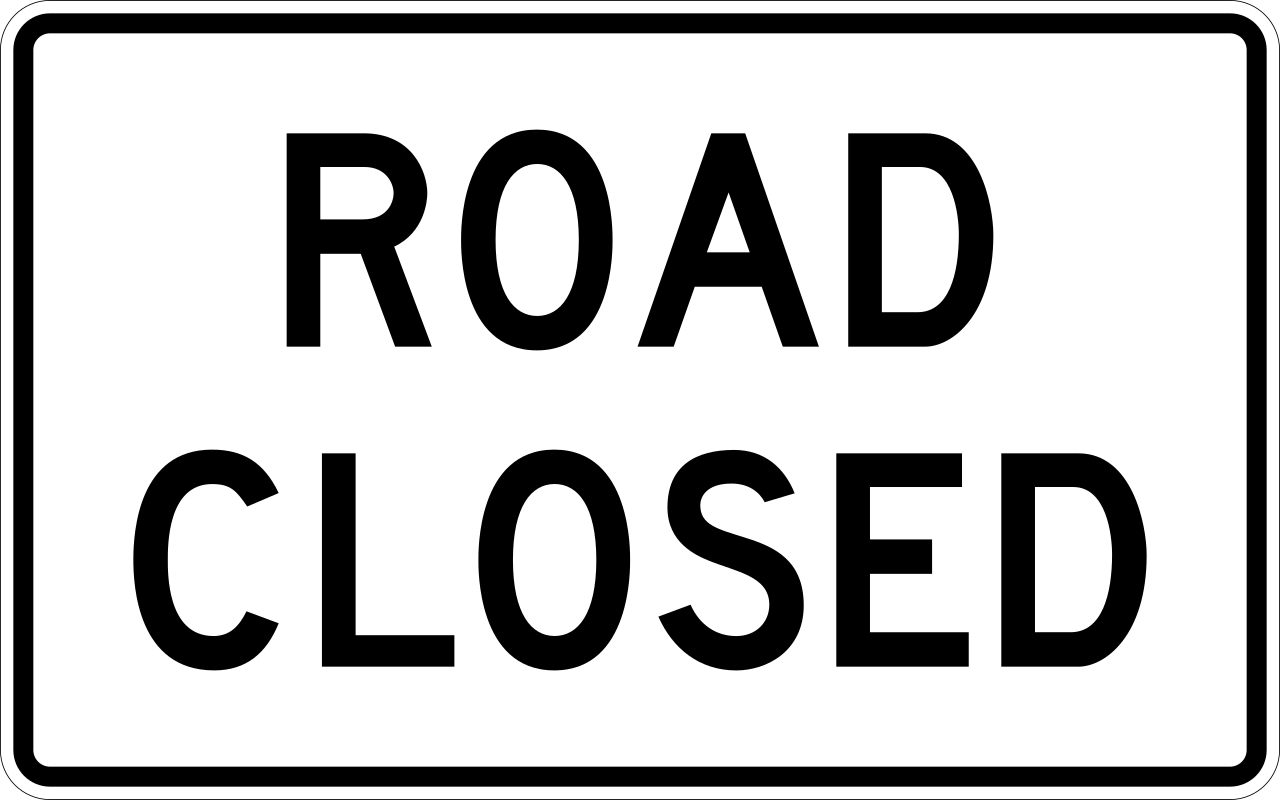
A ROAD CLOSED sign means the road ahead is closed to all traffic except authorized vehicles, like construction equipment or emergency crews. You can't drive past it or around the barricade it sits on. Turn around safely and follow the detour signs to get where you're going.
The sign's official code in the Manual on Uniform Traffic Control Devices (MUTCD), the federal rulebook for road signs, is R11-2. It has a few close relatives that mean something slightly different, and permit tests like to check whether you can tell them apart. Here's how each one works, based on the current MUTCD (11th Edition, Revision 1, December 2025).
What does the ROAD CLOSED sign mean?
According to MUTCD Section 2B.63, the ROAD CLOSED (R11-2) sign should be installed where a road has been "closed to all traffic (except authorized vehicles)." Section 6G.04, which covers work zones, says the same thing: it's used when the roadway is closed to all road users except contractors' equipment or officially authorized vehicles.
In plain terms: if you're a regular driver, this road is not for you right now. It doesn't matter if you live on the other side, if the road looks empty or if you can see that the work is finished.
A few things to know about how it looks and where it's used:
- It's a regulatory sign. That means it tells you about a rule you must follow, not just a hazard to watch for. (More on that group of signs in our guide to regulatory signs.)
- It's a horizontal rectangle. MUTCD Section 2B.63 requires all Road Closed signs to be designed as horizontal rectangles. The standard size is 48 x 30 inches (MUTCD Table 6G-1).
- The wording can change to match the situation. STREET CLOSED (R11-2a), BRIDGE OUT (R11-2b) and PATH CLOSED (R11-2c) are versions of the same sign and mean the same thing for that road, street, bridge or path (MUTCD Section 6G.04).
- Bicycles may be an exception. Where bikes can still use the road past the closure, an EXCEPT BICYCLES plaque may be added under the ROAD CLOSED sign (MUTCD Section 2B.63). If there's no plaque, the closure applies to everyone.
Where is the ROAD CLOSED sign placed?
The ROAD CLOSED sign goes right at the point of closure, usually on a barricade across the road.
MUTCD Section 6G.04 says Road Closed signs should be installed "at or near the center of the roadway on or above a Type 3 Barricade that closes the roadway." It also sets a firm rule: Road Closed signs shall not be used where traffic is still allowed through the work zone with fewer lanes, or where the actual closure is some distance beyond the sign. So when you see a plain ROAD CLOSED sign, the closure is right there, not a mile down the road.
What does a Type 3 Barricade look like?
A barricade is a portable or fixed device with one to three rails, and the MUTCD sorts them into Type 1, Type 2 and Type 3 (MUTCD Section 6K.07). Type 3 is the one used to close a road. According to that section:
- The rails have alternating orange and white stripes that are retroreflective, so they shine in your headlights at night.
- The stripes slope downward at a 45-degree angle in the direction you're supposed to go. If the stripes slope down to the right, that's the direction to turn.
- If you can turn either way, the stripes slope down in both directions from the center.
- If no turn is intended, the stripes slope down toward the center.
- Type 3 Barricades should be used to close or partially close a road, and they may be placed completely across the road or from curb to curb.
For a road that ends or is closed for good (not a work zone), MUTCD Section 2B.75 says the barricade uses red and white stripes instead of orange and white.
What signs warn you before a road closure?
You shouldn't hit a ROAD CLOSED sign by surprise. MUTCD Section 2B.63 requires Road Closed signs to be preceded by an advance warning sign, and by an advance detour sign if there's a detour.
- ROAD CLOSED AHEAD (W20-3). This is an orange, diamond-shaped warning sign placed before the point where a road is closed to all traffic, or to all but local traffic (MUTCD Section 6H.05). It can say AHEAD or give a distance in feet or miles. STREET can replace ROAD.
- DETOUR (W20-2). Another orange diamond, used before a detour onto a different road or route (MUTCD Section 6H.04). It can also show AHEAD or a distance.
MUTCD Section 6H.01 says work zone warning signs are diamond-shaped with black letters on an orange background. During emergencies and incidents, they may be fluorescent pink instead. If you want the full list of orange work zone signs, see our post on construction zone signs.
When you see either of these, slow down, start looking for the detour and get into the right lane early.
What does ROAD CLOSED TO THRU TRAFFIC mean?
ROAD CLOSED TO THRU TRAFFIC (R11-4) and ROAD CLOSED, LOCAL TRAFFIC ONLY (R11-3 series) mean the road is closed further ahead, but you can still use it up to the point of closure if that's where you need to go.
MUTCD Section 6G.05 says these Local Traffic Only signs should be used where drivers follow detours to avoid a closure some distance beyond the sign, "but where local road users can use the roadway to the point of closure." Section 2B.63 adds that they're used where through traffic isn't allowed, but where the highway is open for local traffic up to the closure.
The versions you may see:
- ROAD CLOSED XX MILES AHEAD, LOCAL TRAFFIC ONLY (R11-3). The usual version on rural roads (MUTCD Section 6G.05).
- ROAD CLOSED, LOCAL TRAFFIC ONLY. A shorter version allowed in urban areas.
- ROAD (STREET) CLOSED TO THRU TRAFFIC (R11-4). Also used in urban areas.
- A street name or landmark instead of the mileage. In cities, the sign may name the intersecting street or a well-known destination where the closure is (MUTCD Section 6G.05).
- STREET CLOSED (R11-3a) and BRIDGE OUT (R11-3b). Substitutes for the R11-3 when they fit better.
All of these are horizontal rectangles, 60 x 30 inches (MUTCD Table 6G-1).
Who counts as "local traffic"?
The MUTCD doesn't list who qualifies. What it does say is that local road users can use the road up to the point of closure. In practice, that's people whose destination is on the open part of the road, like a home, business or school before the closure. If you're just trying to get through to the other side, you're "thru traffic," and you need to take the detour.
Also note that at these closures, barricades usually don't go all the way across the road, so local drivers can get in (MUTCD Section 6K.07). A gap in the barricade isn't an invitation to drive through if you're not local.
What do detour signs look like?
Detour signs guide you around the closure and back to your route. MUTCD Section 6I.02 says each detour shall be adequately marked with standard temporary route signs and destination signs. The main ones:
- Detour Arrow (M4-10). A horizontal sign with an arrow pointing left or right. It should normally be mounted just below the ROAD CLOSED sign, so it's often the first thing that tells you which way to turn (MUTCD Section 6I.02).
- DETOUR (M4-9). A DETOUR sign used on roads without route numbers, in emergencies, for short-term closures or for short detours. A street name sign should be placed above it or the street name should be included on it (MUTCD Section 6I.02).
- DETOUR plaque (M4-8P). A small plaque mounted on top of a route number sign. It marks a temporary route that goes around a closed section and rejoins the highway past it (MUTCD Section 6I.02).
- END DETOUR (M4-8a) or END plaque (M4-8bP). Tells you the detour is over and you're back on your normal route (MUTCD Section 6I.02).
Temporary guide signs in work zones have black letters on an orange background (MUTCD Section 6I.01). For emergencies and incidents, detour signs may be black on fluorescent pink instead (MUTCD Section 6I.02).
The MUTCD also has separate detour signs for people walking and biking, like the Pedestrian/Bicyclist Detour (M4-9a), used when a sidewalk or bike path is closed.
What should you do when you see a ROAD CLOSED sign?
Here's what to do, step by step:
- Slow down when you see the advance warning. A ROAD CLOSED AHEAD or DETOUR sign means you'll need to turn soon.
- Don't drive around the barricade. The sign means the road is closed to everyone but authorized vehicles, even if it looks clear.
- Look for the Detour Arrow. It's usually right below the ROAD CLOSED sign. The barricade stripes also slope toward the direction you're meant to turn.
- Turn safely. Use your signal, check mirrors and blind spots, and watch for workers and other drivers who are turning too.
- Follow the detour signs until you see END DETOUR. Don't guess a shortcut. Detour routes are set up to bring you back to your road.
- If it says LOCAL TRAFFIC ONLY or CLOSED TO THRU TRAFFIC, only continue if your destination is before the closure. Otherwise, take the detour.
The New York State DMV's driver's manual sums up the work zone mindset well: "Decrease speed! Be Alert! Obey the signs!" It also notes that "some signs can indicate a detour that allows you to avoid the work zone." (If you're studying in New York, here's our New York permit practice test.)
Can you get in trouble for driving around a ROAD CLOSED sign?
Yes. ROAD CLOSED is a regulatory sign, so it carries the weight of a traffic rule. Penalties depend on your state, so check your state's driver's handbook or vehicle code for the exact rules and fines.
Some states have laws aimed at specific closures. In Arizona, for example, a driver who drives onto a public road that is flooded and barricaded because of flooding is liable for the cost of any emergency response needed to rescue them, their passengers or their vehicle. That cost can be up to $2,000 per incident, and an insurance policy may exclude it (Arizona Revised Statutes § 28-910). (Studying in Arizona? Try our Arizona permit practice test.)
Beyond fines, the real reason closures exist is safety. Roads get closed for washed-out bridges, flooding, deep excavations and heavy equipment. A road that looks fine from the barricade may not be fine a few hundred feet later.
How does the road closed sign show up on the permit test?
Permit tests usually check road closure signs in a few ways:
- Shape and color. Knowing that work zone warning signs like ROAD CLOSED AHEAD are orange diamonds, while the ROAD CLOSED sign itself is a rectangle on the barricade. Our guide to road sign meanings covers how shapes and colors work.
- ROAD CLOSED vs. LOCAL TRAFFIC ONLY. One means nobody but authorized vehicles. The other means local drivers can go up to the closure.
- What to do. The right answer is almost always to slow down, not drive around the barricade and follow the detour.
- Barricade stripes. Which way to turn based on how the stripes slope.
If you want to see how these questions are worded, try our permit practice tests to study for your permit test. For the other orange and yellow signs you'll meet on the road, see our guide to warning signs.
Sources
- Manual on Uniform Traffic Control Devices, 11th Edition, Revision 1 (Federal Highway Administration)
- MUTCD 11th Edition, Revision 1, Chapter 2B: Regulatory Signs, Barricades, and Gates (Federal Highway Administration)
- MUTCD 11th Edition, Revision 1, Part 6: Temporary Traffic Control (Federal Highway Administration)
- New York State Driver's Manual, Chapter 8: Defensive Driving (New York State DMV)
- A.R.S. § 28-910, Liability for emergency responses in flood areas (Arizona State Legislature)
Free permit practice test for your state
Ready to check what you know? Take a free 10-question test from your state's driver handbook, with every answer explained. No sign-up needed. See questions and pass marks for every state.
- Alabama
- Alaska
- Arizona
- Arkansas
- California
- Colorado
- Connecticut
- Delaware
- Florida
- Georgia
- Hawaii
- Idaho
- Illinois
- Indiana
- Iowa
- Kansas
- Kentucky
- Louisiana
- Maine
- Maryland
- Massachusetts
- Michigan
- Minnesota
- Mississippi
- Missouri
- Montana
- Nebraska
- Nevada
- New Hampshire
- New Jersey
- New Mexico
- New York
- North Carolina
- North Dakota
- Ohio
- Oklahoma
- Oregon
- Pennsylvania
- Rhode Island
- South Carolina
- South Dakota
- Tennessee
- Texas
- Utah
- Vermont
- Virginia
- Washington
- West Virginia
- Wisconsin
- Wyoming