

Right of Way Rules: Who Goes First, Explained
Who goes first at four-way stops, uncontrolled intersections, left turns and roundabouts depends on your state. Here are the rules from each state handbook we reviewed.
Alvaro Peña
Founder of GetMyPermit
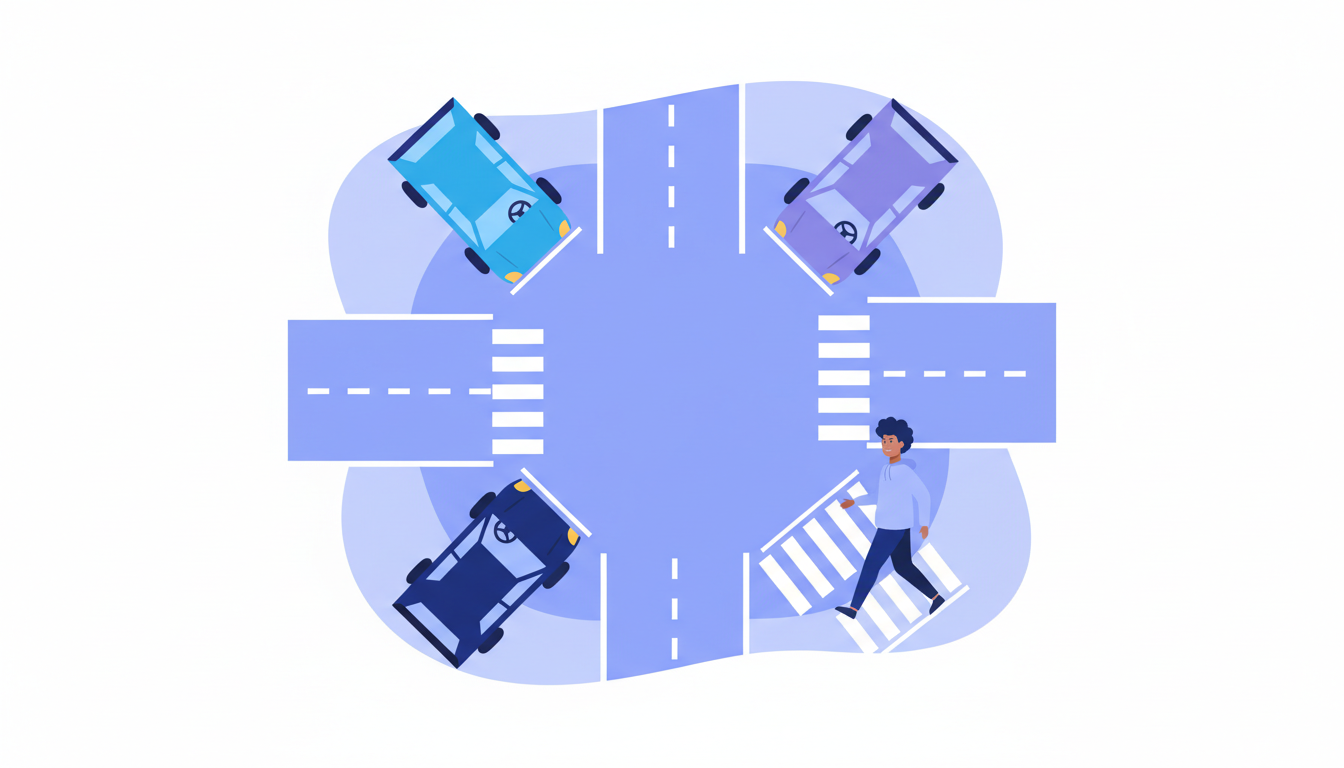
At a four-way stop, the vehicle that comes to a complete stop first goes first, and if two arrive together, the vehicle on the right goes first in the states that cover that tie. Where there is no stop sign, yield sign or signal, the vehicle on your right has priority in each state listed below that covers a tie, though details differ by state and situation.
Emergency vehicles, school buses and people in crosswalks also come before you under the handbooks below. Each rule is tied to the state whose handbook says it, so a rule from one state does not automatically apply in another. If your state is not listed, check your state's DMV.
Four-way stops and stop-sign intersections
Stop at the line, then wait for your turn. These are the arrival-order rules in each handbook.
- Alabama: The passages retrieved do not describe a separate four-way-stop rule. The traffic-light section says to treat a dark signal as a four-way stop (p. 63).
- Arizona: Uncontrolled intersections and inoperative signals are treated as four-way stops. The passages retrieved do not state a separate arrival-order rule, so the tie rule below applies (pp. 28–29).
- Arkansas: At a three-, four- or all-way stop, the driver who reaches the intersection first goes first after a complete stop. At all-way stops, yield to the vehicle that arrived first (pp. 51–52).
- Colorado: Yield to the vehicle that arrived first. A tie goes to the vehicle on the right (p. 14).
- Connecticut: The driver who arrives first goes first after a full stop. A tie goes to the vehicle on the right (p. 38).
- Florida: After a full stop, vehicles go in arrival order. At an all-way stop, traffic in all directions stops. When vehicles arrive together, each driver yields to the driver on the right (pp. 55, 70).
- Georgia: All drivers yield to pedestrians. Otherwise the first to arrive goes first, and a tie yields to the vehicle on your right (p. 18).
Uncontrolled intersections with no signs or signal
At an intersection without a stop sign, yield sign or signal, the tie-breaking rule depends on your state. California's handbook says the vehicle that arrives first goes first. Check your state's rule below.
- Alabama: The driver on the left yields to the driver on the right when two vehicles arrive about the same time. Entering at an unlawful speed forfeits the right of way (p. 65).
- Alaska: The driver on the left yields to the driver on the right. Approaching from the right gives no automatic right of way. Non-motorized users have the right of way over motorized vehicles (p. 38).
- Arizona: The driver on the left yields to the driver on the right in a tie. At a T intersection, the driver on the road that ends yields to the through road. A flashing red light means stop, like a stop sign (pp. 28–29).
- Arkansas: Where there is no stop sign or signal, drivers yield to vehicles approaching from the right. Drivers may not enter an intersection unless they can clear it without stopping in it (pp. 40, 51).
- California: Without stop or yield signs, the vehicle that arrives first goes first. For a simultaneous arrival, yield to the vehicle on your right. At a T intersection without signs, the through road has the right of way (p. 45).
- Colorado: The driver on the left yields to the driver on the right (p. 14).
- Connecticut: With no stop sign, yield sign or signal, yield to vehicles from the right (p. 38).
- Delaware: At an intersection with no stop sign, yield sign or signal, yield to vehicles from the right, though yielding to all is safest (p. 86).
- Florida: When vehicles arrive together, each driver yields to the driver on the right. At a two-way stop, the turning vehicle yields to the through vehicle. Driveway and alley entries yield to vehicles on the main road (p. 70).
- Georgia: The driver on the left yields to the driver on the right (p. 18).
Left turns
When you turn left, you yield to oncoming traffic. These are the oncoming-traffic rules in each handbook.
- Alabama: Yield to oncoming traffic that is in the intersection or too close to be safe. The same applies to turns into a driveway or alley (p. 65).
- Alaska: At a flashing yellow arrow, yield to oncoming traffic, pedestrians and vehicles in the intersection. At a green arrow, you have the right of way but must still yield to those already in or entering the intersection (p. 56).
- Arkansas: Drivers turning left yield to oncoming straight traffic (p. 47).
- California: Yield to pedestrians and to any approaching vehicle close enough to be dangerous. When turning into a two-way center left-turn lane, respect the right of way of vehicles already in that lane (pp. 25, 45).
- Colorado: Yield to all oncoming traffic unless you have a green arrow or arrived first at a four-way stop (p. 14).
- Connecticut: Yield to oncoming vehicles going straight (p. 38).
- Delaware: Turning left yields to oncoming straight traffic (p. 86).
- Florida: At a red arrow, yield to pedestrians and oncoming traffic. At a green arrow, yield to vehicles and pedestrians in the intersection. At a flashing yellow arrow, turn with caution and yield to oncoming traffic and pedestrians (p. 60).
- Georgia: Yield to all traffic from the opposite direction before turning left or entering an alley or driveway (p. 18).
Pedestrians and white canes
Pedestrians get the right of way in crosswalks, with extra protection for people using white canes or guide dogs. The details are by state.
- Alabama: A blind pedestrian using a white cane or guide dog has right of way at intersections, and drivers must stop for them. Stop for school children and school safety patrols directing movement, and yield to pedestrians in crosswalks (pp. 65, 67).
- Alaska: At a signal, a green light does not clear pedestrians or vehicles still caught in the intersection (p. 40).
- Arizona: Yield to pedestrians in marked or unmarked crosswalks, including after a green light (p. 29).
- Arkansas: Pedestrians in or about to enter a crosswalk have right of way, and white-cane and guide-dog users have absolute right of way. Drivers leaving a driveway, alley or parking lot yield to pedestrians on the sidewalk (pp. 40, 46–47).
- California: Pedestrians always have the right of way. Yield to them in marked or unmarked crosswalks (pp. 45, 47).
- Colorado: Pedestrians have right of way at all intersections and crosswalks. Come to a complete stop and let them pass (p. 13).
- Connecticut: Pedestrians in a crosswalk, marked or unmarked, have right of way. Stop when a pedestrian steps to the curb at the crosswalk entrance (pp. 18, 38).
- Delaware: Pedestrians in crosswalks, on a WALK signal, and crossing with a white cane or guide dog have right of way (pp. 70, 93).
- Florida: Stop for pedestrians at marked crossings or intersections, and do not pass a vehicle stopped at a crosswalk. At school crossings, yield and stop at the stop line when children or crossing guards are in the crosswalk (pp. 96–97).
- Georgia: At an all-way stop, all drivers yield to pedestrians. At a green light, proceed only after stopping for pedestrians and yielding to vehicles in the intersection (pp. 18, 35).
Emergency vehicles
Pull over when an emergency vehicle is coming with lights or siren. The steps differ by state.
- Alabama: For flashing red or blue lights and a siren, pull to the curb or roadside and stop. If you are already in an intersection, clear it first (p. 63).
- Alaska: For flashing red or blue lights, with or without a siren, move right, clear the intersection and stop. Do not follow an emergency vehicle responding to an emergency within 500 feet (p. 76).
- Arizona: Move right and stop. On a four-lane road, change lanes away from the emergency vehicle if possible. Stay at least 500 feet behind a fire vehicle and 300 feet behind a police vehicle responding to an emergency. Move over one lane for a vehicle with flashing lights at the roadside, or slow down if moving over is unsafe. Funeral processions led by an escort with flashing red or blue lights have right of way (pp. 30–31).
- California: With siren and red lights, drive to the right edge and stop. If you are already in an intersection, continue through and then pull over. It is illegal to follow within 300 feet of a fire engine or other emergency vehicle with lights or siren on. For stationary emergency vehicles with hazard lights, move over and slow down (p. 51).
- Colorado: For a siren, air horn or flashing lights, pull to the right and stop. If you are in an intersection, clear it first. Slow to 25 mph if the limit is 45 mph or less (pp. 11, 14).
- Connecticut: For a siren, air horn or flashing red or blue light, pull right and stop. If you are in an intersection, drive through first. Green lights do not excuse you from yielding to emergency vehicles (pp. 39, 47).
- Delaware: For a siren, air horn, or red or blue flashing lights, pull right. If you are in an intersection, clear it first (p. 87).
- Florida: Following an emergency vehicle responding to an emergency closer than 500 feet is illegal (p. 70).
- Georgia: For lights and siren, move to the shoulder or as far right as possible and stop. Do not block an intersection (p. 18).
School buses
A school bus with red lights flashing means stop. Where you must stop depends on the state and the road.
- Alabama: Stop for a bus with an extended stop arm and flashing red lights, including when meeting or following it. On a divided highway with two lanes separated in each direction, you do not stop for the opposing bus (p. 63).
- Alaska: Stop for a bus with red flashing lights and an extended stop arm. Drivers meeting or following the bus must stop (p. 41).
- Arizona: Stop completely before reaching a bus with its arm extended and lights flashing, from either direction. On divided roads, you may proceed with caution if the bus is in the opposite lanes (p. 31).
- Arkansas: School bus rules were not retrieved. The handbook's danger-zone illustration appears on p. 25.
- California: School bus rules were not retrieved. Check the California handbook.
- Colorado: Stop at least 20 feet back when red lights flash. On two-lane and four-lane undivided roads, both directions stop. On divided roads, only vehicles behind the bus stop. On five-plus-lane roads with a shared center turn lane, only vehicles in both lanes behind the bus stop (p. 23).
- Connecticut: Stop for a bus with red lights flashing from either direction. Stop is not required when a median or barrier separates the roadway (p. 39).
- Delaware: Stop before reaching a bus loading children from either direction, except on the opposite side of a divided highway with four or more lanes. Yellow flashing lights come on about 10 seconds before the red lights, so prepare to stop (p. 87).
- Florida: For a bus displaying a stop signal on two-lane or undivided roads, stop from both directions. On divided roads with a raised barrier or an unpaved median of at least 5 feet, opposite traffic may proceed. Same-direction traffic must always stop (p. 97).
- Georgia: With flashing yellow lights, slow down and prepare to stop. Once red lights and the stop arm are out, passing is unlawful. Opposite traffic on a median-divided highway need not stop (pp. 19).
Roundabouts
Roundabout rules vary by state. In most of the handbooks reviewed, drivers yield to traffic already in the circle. The details below are by state.
- Alabama: Yield to traffic already in the circle and to pedestrians and bicyclists before entering. Enter on the right when there is a gap. Never turn left to enter, and do not stop inside unless needed to avoid a crash. Yield to emergency vehicles, pulling over if you have not yet entered (pp. 57, 59, 60).
- Alaska: Slow down and enter to the right of the center island at a gap. Yield to circulating traffic on the left, and to pedestrians and bicyclists when entering and exiting (p. 39).
- Arizona: Yield to pedestrians and bicyclists in the crossing, enter to the right, yield to vehicles already in the circle, and yield to large trucks entering at the same time (p. 22).
- Arkansas: Drivers entering a traffic circle or rotary yield to vehicles already in it. Roundabout pages 49–50 were not in the supplied text, so check the manual (p. 47).
- Colorado: Yield to traffic on the left before entering, yield to pedestrians and bicyclists, and do not stop unless traffic prevents merging (p. 13).
- Connecticut: Entering traffic yields to circulating traffic and pedestrians. Take the proper lane, and do not stop in the circle to let others in (p. 39).
- Delaware: Yield to pedestrians and traffic already in the circle. Do not stop inside, and keep to the right of the central island (p. 84).
- Florida: Enter after yielding to traffic already in the circle. If there is no traffic, no yield is needed. Do not change lanes or stop inside (p. 71).
- Georgia: Enter to the right, yield to traffic already in the circle, and exit to the right (p. 38).
Merging
- Colorado: Yield to all vehicles on the roadway you are merging into. Do not merge if another vehicle must slow down (p. 14).
- Delaware: At a lane reduction, drivers in the merging lanes use both lanes and alternate at the reduction point, a zipper merge (p. 75).
- Florida: When merging onto a limited-access highway, merge when it is safe and yield to highway traffic (p. 71).
- Georgia: Adjust your speed and position to merge safely. Merging traffic may need to yield (p. 18).
Stop and yield signs
- Alabama: At a yield sign, slow down and stop if needed to yield to vehicles and pedestrians legally crossing (p. 65).
- Alaska: At a stop sign, stop behind the crosswalk or stop line, then yield to pedestrians, bicyclists and traffic. At a yield sign, slow down and stop if needed for approaching traffic or pedestrians (p. 41).
- Florida: At a yield sign, slow down and give vehicles crossing your path the right of way (p. 55).
- Georgia: At a stop sign, come to a stop, then proceed only after yielding to vehicles in or close to the intersection. At a yield sign, slow down, stop if needed, and proceed only when safe (pp. 18, 29).
- North Carolina: Stop signs are octagonal and require a full stop at the stop line. Without a line, stop before entering where you can see the cross street. Yield signs are triangles (p. 43).
Colorado's facts sheet (p. 25) says that bicyclists 15 and older may, under a 2022 law, treat stop signs as yield signs and stop lights as stop signs when the intersection is clear and they already have the right of way. This applies to bicyclists only.
Not confirmed: check your state's DMV
The handbooks in our research do not confirm right-of-way rules for the places below. Check your state's DMV before relying on a rule from another state.
- Arkansas: Emergency vehicle and merging rules were not retrieved.
- Hawaii: Right-of-way, four-way stop, roundabout and school bus rules are not confirmed.
- Iowa: Right-of-way rules are not confirmed.
- Idaho, Illinois and Indiana: Specific right-of-way rules were not retrieved.
- Massachusetts, Nevada and North Dakota: Specific rules were not retrieved.
- Oregon: Right-of-way rules are not confirmed. See the Oregon driver manual, where pages 105–110 were not in the supplied text.
- Pennsylvania: Not confirmed. Its driver's manual is the source to check.
- Maryland, Michigan, Mississippi, Montana, New Hampshire, New Mexico, New York, Ohio, Rhode Island, South Carolina, South Dakota, Virginia and Wyoming: Not confirmed.
- Washington: Not confirmed. Check the current Washington DOL driver guide.
- Washington, D.C.: Not researched. Check dmv.dc.gov.
To practice these rules, try the GetMyPermit practice test.
Sources
- Alabama driver license manual (ALEA)
- Alaska driver manual (DMV)
- Arizona driver handbook (ADOT MVD)
- Arkansas driver manual (DPS)
- California driver handbook (DMV)
- Colorado driver handbook (DMV)
- Connecticut driver manual (DMV)
- Delaware driver manual (DMV)
- Florida driver handbook (FLHSMV)
- Georgia driver manual 2023–2024 (DDS)
- Oregon driver manual (ODOT DMV)
- Pennsylvania driver's manual (PennDOT)
Free permit practice test for your state
Ready to check what you know? Take a free 10-question test from your state's driver handbook, with every answer explained. No sign-up needed. See questions and pass marks for every state.
- Alabama
- Alaska
- Arizona
- Arkansas
- California
- Colorado
- Connecticut
- Delaware
- Florida
- Georgia
- Hawaii
- Idaho
- Illinois
- Indiana
- Iowa
- Kansas
- Kentucky
- Louisiana
- Maine
- Maryland
- Massachusetts
- Michigan
- Minnesota
- Mississippi
- Missouri
- Montana
- Nebraska
- Nevada
- New Hampshire
- New Jersey
- New Mexico
- New York
- North Carolina
- North Dakota
- Ohio
- Oklahoma
- Oregon
- Pennsylvania
- Rhode Island
- South Carolina
- South Dakota
- Tennessee
- Texas
- Utah
- Vermont
- Virginia
- Washington
- West Virginia
- Wisconsin
- Wyoming