

Warning Signs: What Yellow Road Signs Mean
Warning signs are yellow diamonds with black symbols or words that warn you of hazards ahead, like curves, merges and crossings. See what each type means.
Bianca Galvan
Product & Content at GetMyPermit
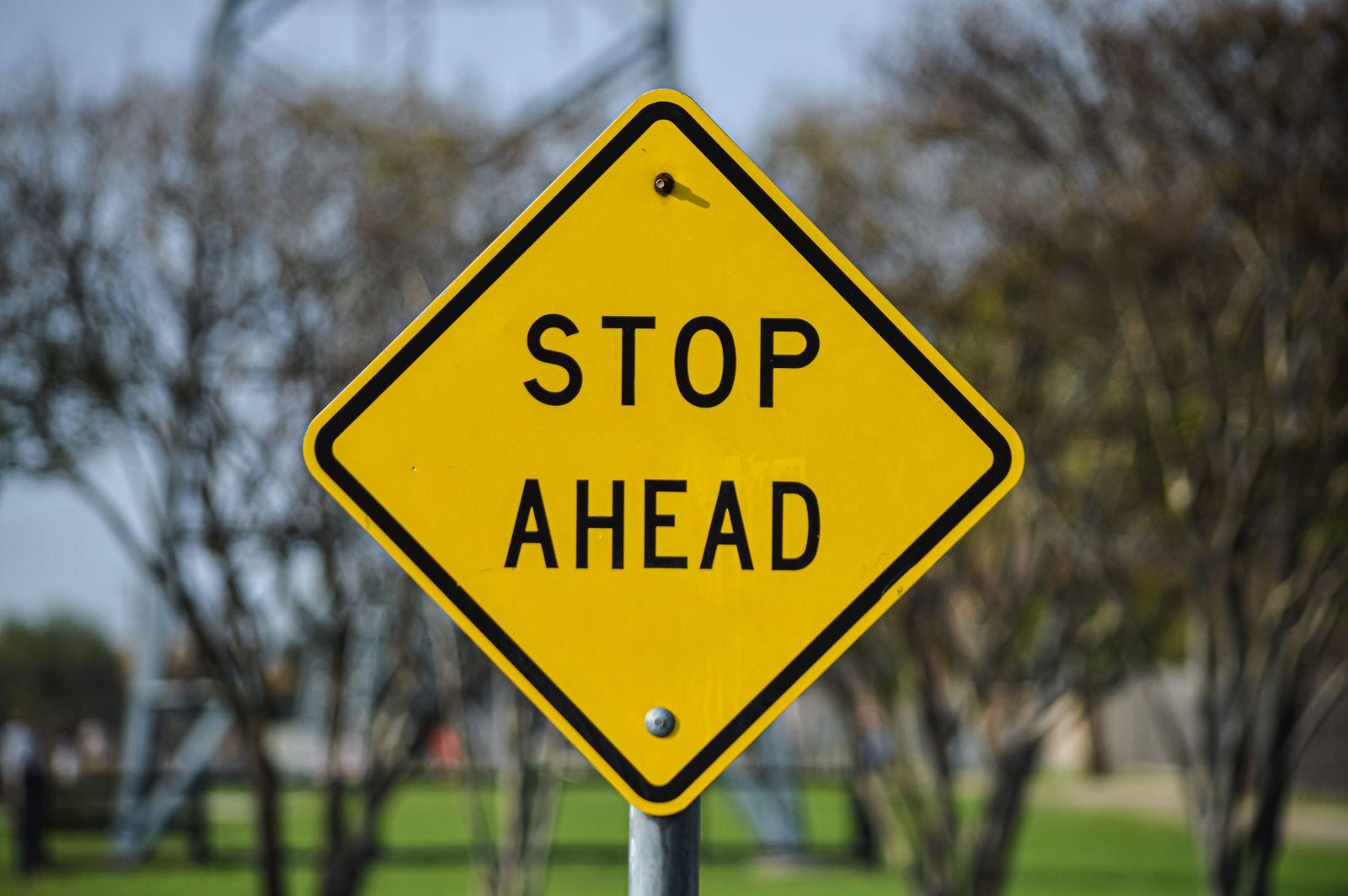
Warning signs are the yellow, diamond-shaped signs with black symbols or words that tell you about a hazard or a change in the road ahead, like a curve, a merge, a crossing or a traffic signal you can't see yet. They don't give orders the way regulatory signs do. They give you time to slow down and get ready before you reach the problem.
How they look is set by the federal Manual on Uniform Traffic Control Devices (MUTCD), 11th Edition, mostly in Chapter 2C. If you want a quick tour of every sign shape and color first, see our guide to road sign meanings. This post goes deeper on warning signs only.
What are warning signs?
The MUTCD sorts signs by what they do (Section 2A.03). Regulatory signs give notice of traffic laws. Guide signs show routes and destinations. Warning signs "give notice of a situation that might not be readily apparent."
State handbooks put it in plainer words. Pennsylvania says warning signs "tell you about conditions on or near the road ahead." Oregon says they "alert you to known possible hazards or a change in road conditions ahead."
Warning signs go up before the hazard, so you have time to react. The MUTCD's placement guide (Table 2C-3) shows how far ahead. On a 55 mph road, it suggests about 990 feet for signs like Merge or Right Lane Ends, and about 495 feet for signs like Stop Ahead or Signal Ahead. Engineers can adjust those distances for the site.
Section 2C.01 also requires warning signs to be retroreflective or lit, so you can see them at night.
Why are warning signs yellow diamonds?
Because the MUTCD says so. Section 2C.02 states that, unless the manual says otherwise, "all warning signs shall be diamond-shaped (square with one diagonal vertical) with a black legend and border on a yellow background."
The color. The MUTCD color code (Section 1D.05) gives each sign color a meaning, and yellow means "warning." Section 2A.06 also allows a fluorescent version of standard yellow.
The shape. Table 2A-1 in Chapter 2A assigns the diamond to the warning series. Section 2A.05 even forbids changing it, such as "cutting off the left and right points of a diamond."
A fixed shape and color lets you react sooner. Georgia's manual tells drivers to know signs by shape and color "so that they may recognize them from a distance."
Are all warning signs yellow diamonds?
No. These are the exceptions you are most likely to see, and to be asked about:
- Fluorescent yellow-green. Warning signs for schools and school buses must have a black legend on a fluorescent yellow-green background (Section 2C.02). Signs for pedestrians, bicyclists and playgrounds may use yellow or fluorescent yellow-green. The School sign (S1-1) also has its own shape: a pentagon (Table 2A-1).
- Orange for work zones. In Part 6, Section 6H.01 says temporary traffic control (work zone) warning signs are diamonds with a black legend and border on an orange background. The MUTCD color code gives orange the meaning "temporary traffic control." Pennsylvania's manual puts it simply: work zone signs are "orange with black lettering instead of yellow with black lettering." See our guide to construction zone signs.
- The pennant. The NO PASSING ZONE sign (W14-3) is "a pennant-shaped isosceles triangle with its longer axis horizontal and pointing to the right." It goes on the left side of the road where a no-passing zone begins (Section 2C.53). Pennsylvania calls it "the only pennant-shaped warning sign."
- The circle. The Grade Crossing Advance Warning sign (W10-1) is round and yellow (Table 2A-1). It warns that a railroad crossing is ahead. Our guide to railroad crossing signs covers it in detail.
What are the main types of warning signs?
Each warning sign has an MUTCD code starting with "W," grouped by the kind of situation. Here are the groups new drivers see most.
Curves and turns (W1 series)
These signs show which way the road bends (Section 2C.07):
- Curve (W1-2) is the standard sign for a curve ahead.
- Turn (W1-1) is used instead when the advisory speed for the curve is 30 mph or less.
- Reverse Turn (W1-3) and Reverse Curve (W1-4) warn of two bends in opposite directions less than 600 feet apart.
- Winding Road (W1-5) means three or more curves in a row. See our winding road sign guide.
- Chevron Alignment (W1-8) signs are vertical rectangles placed on the outside of the curve itself to show you the path (Section 2C.08).
Pennsylvania's advice for a curve sign: slow down, stay in the center of your lane, and get ready to steer through the bend.
Intersections (W2 series)
Cross Road (W2-1), Side Road (W2-2, W2-3, W2-3a), T-Intersection (W2-4) and Y-Intersection (W2-5) signs warn of an intersection ahead and "the possibility of turning or entering traffic" (Section 2C.41).
Stop Ahead, Yield Ahead and Signal Ahead (W3 series)
These are called Advance Traffic Control signs (Section 2C.35). The MUTCD requires a Stop Ahead (W3-1), Yield Ahead (W3-2) or Signal Ahead (W3-3) sign when the STOP sign, YIELD sign or signal isn't visible from far enough away for you to react. Curves, structures, trees or parked cars can block the view.
- Stop Ahead (W3-1): a STOP sign is coming. Georgia says to "begin to slow down and be prepared to stop."
- Yield Ahead (W3-2): a YIELD sign is coming. See our yield sign guide.
- Signal Ahead (W3-3): a traffic light is coming. Oregon says to "slow down and be ready to stop."
Merges and lane changes (W4, W6 and W9 series)
- Merge (W4-1): two separate roadways come together and traffic from the other road may move into your lane (Section 2C.45).
- Lane Ends (W4-2) and RIGHT (LEFT) LANE ENDS (W9-1): the number of lanes in your direction is going down (Section 2C.47). The MUTCD says a Merge sign must not replace a Lane Ends sign when lanes on the same road merge because the road gets narrower. See our Road Narrows sign guide.
- LANES MERGE (W9-4): two lanes become one, and both lanes have to merge (Section 2C.48).
- Added Lane (W4-3): two roads join and a lane is added, so no merging is required (Section 2C.46).
- Divided Highway (W6-1): a median or barrier will separate the two directions ahead. See our divided highway sign guide.
Road conditions (W6-3, W8 and W12 series)
- Two-Way Traffic (W6-3): you are moving from a divided road onto a road with traffic in both directions. See our two-way traffic sign guide.
- Slippery When Wet (W8-5): the road can get unexpectedly slippery. See our slippery when wet sign guide.
- Low Clearance (W12-2): a bridge or structure ahead has a low clearance, and the sign shows the height. See our low clearance sign guide.
- BUMP (W8-1) and DIP (W8-2): a sharp rise or drop in the road ahead. These may come with an advisory speed plaque (Section 2C.26).
Crossings (W11 series and school signs)
These signs warn that people, bikes or animals may enter the road (Sections 2C.54 and 2C.55):
- Pedestrian (W11-2) and Bicycle (W11-1) signs can be yellow or fluorescent yellow-green. See our Pedestrian Crossing sign guide.
- Deer (W11-3) warns that deer may cross the road in this area.
- At the crossing itself, the sign has a diagonal downward-pointing arrow plaque (W16-7P) below it. Before the crossing, a plaque that says AHEAD or a distance in feet may be used instead.
- The School (S1-1) sign works the same way: with the downward arrow plaque, it marks the spot where schoolchildren cross (Part 7, Section 7B.02).
Advisory speed plaques (W13-1P)
The Advisory Speed plaque is the small square plaque with a speed on it, mounted under a warning sign (Section 2C.59). Key rules:
- It is only used with a warning sign, never on its own.
- The speed is a multiple of 5 mph, set by an engineering study.
Oregon says it "advises the safe speed for freeway ramps and curves." In Pennsylvania's example, a plaque under a curve sign means 25 mph is the highest speed you should travel around that curve.
What should you do when you see a warning sign?
Every warning sign is asking you to get ready:
- Slow down. Ease off the gas early, especially for curves, turns, bumps and dips.
- Follow the advisory speed if there is a plaque under the sign.
- Look for the hazard the sign shows, like a lane ending or a deer crossing.
- Be ready to stop for Stop Ahead, Yield Ahead and Signal Ahead signs, since Pennsylvania notes a line of vehicles may already be stopped ahead.
- Adjust for weather. For Slippery When Wet, Pennsylvania says to reduce your speed, increase your following distance and avoid quick acceleration or braking.
California's handbook says to "obey all warning signs regardless of their shape or color," and Oregon reminds drivers that "you are ultimately responsible for recognizing and reacting correctly to changing conditions, signed or not."
How do warning signs show up on the permit test?
Pennsylvania, for example, says its knowledge test "will measure your knowledge of traffic signs," along with driving laws and safe driving practices.
Most sign questions test whether you can identify a sign by shape and color alone. The review questions in Pennsylvania's driver manual are a good example:
- One asks what "a yellow and black diamond-shaped sign" does. The correct answer is that it warns you about conditions on or near the road. A wrong choice is "tells you about road construction ahead," which is the job of orange signs.
- Another shows only a sign's shape and color and asks which sign it is. The answer is No Passing Zone, the pennant.
Here is a quick cheat sheet to memorize:
- Yellow diamond: warning
- Orange diamond: work zone
- Fluorescent yellow-green: school, school bus, pedestrian, bicycle or playground
- Pentagon: school
- Pennant (sideways triangle): No Passing Zone
- Round yellow sign: railroad crossing ahead
Then test yourself with real sign questions on our free permit practice test.
Sources
- FHWA MUTCD 11th Edition, Chapter 2C: Warning Signs and Object Markers (PDF)
- FHWA MUTCD 11th Edition, Chapter 2A: General (PDF)
- FHWA MUTCD 11th Edition, Part 1: General (PDF)
- FHWA MUTCD 11th Edition, Part 6: Temporary Traffic Control (PDF)
- FHWA MUTCD 11th Edition, Part 7: Traffic Control for School Areas (PDF)
- Pennsylvania Driver's Manual, PUB 95 (PDF)
- Oregon Driver Manual 2026-2027 (PDF)
- Georgia Department of Driver Services: Drivers Manual
- California DMV: Driver Handbook, Laws and Rules of the Road
Free permit practice test for your state
Ready to check what you know? Take a free 10-question test from your state's driver handbook, with every answer explained. No sign-up needed. See questions and pass marks for every state.
- Alabama
- Alaska
- Arizona
- Arkansas
- California
- Colorado
- Connecticut
- Delaware
- Florida
- Georgia
- Hawaii
- Idaho
- Illinois
- Indiana
- Iowa
- Kansas
- Kentucky
- Louisiana
- Maine
- Maryland
- Massachusetts
- Michigan
- Minnesota
- Mississippi
- Missouri
- Montana
- Nebraska
- Nevada
- New Hampshire
- New Jersey
- New Mexico
- New York
- North Carolina
- North Dakota
- Ohio
- Oklahoma
- Oregon
- Pennsylvania
- Rhode Island
- South Carolina
- South Dakota
- Tennessee
- Texas
- Utah
- Vermont
- Virginia
- Washington
- West Virginia
- Wisconsin
- Wyoming