

Railroad Crossing Signs: Crossbuck and Advance Warning Explained
The round yellow sign warns a railroad crossing is ahead; the white X crossbuck marks the crossing and means yield to trains. Here's what each requires.
Bianca Galvan
Product & Content at GetMyPermit
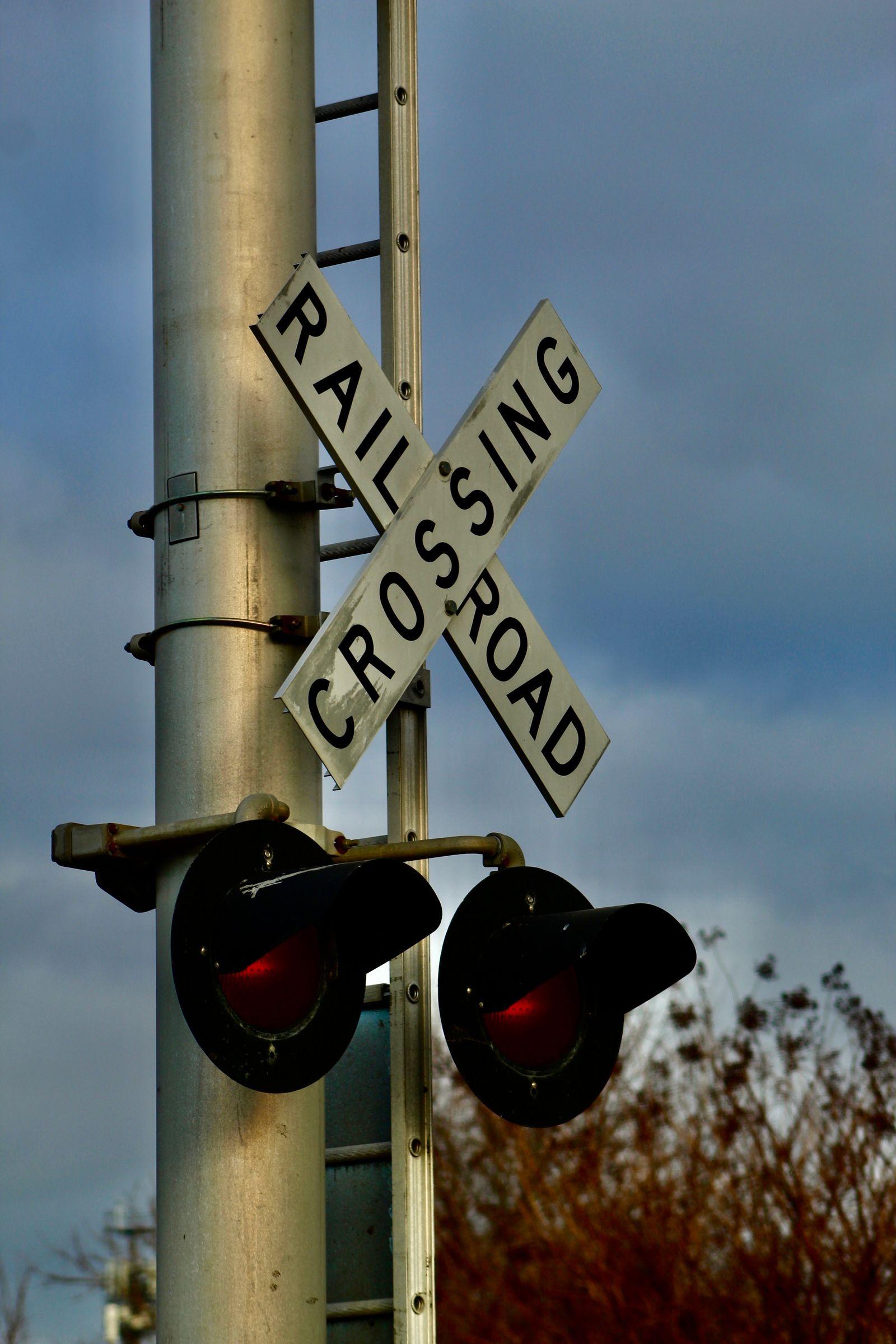
Railroad crossing signs come in two main types. The round yellow advance warning sign tells you a crossing is ahead, so slow down, look, and listen. The white X-shaped crossbuck sign marks the crossing itself and, in most states, means you must yield to any train.
If red lights flash, gates come down, or a STOP sign is posted, you must stop before the tracks. State handbooks such as California's and Oregon's put that stopping point at least 15 feet from the nearest rail.
Below is what each sign means, with codes from the federal sign manual (MUTCD, 11th Edition) and the rules state handbooks test you on.
What does the round yellow railroad crossing sign mean?
The round yellow sign is the Grade Crossing Advance Warning sign (W10-1). It has a black X and the letters "RR." The New York driver's manual describes it as "Yellow with black letters 'RR' and 'X' symbol" and says it means a railroad crossing is ahead: use caution and be prepared to stop.
Its shape is unique. In MUTCD Section 2A.05 (Table 2A-1), the circle is reserved for this one sign, the same way the octagon is reserved for STOP. Most other warning signs are yellow diamonds (Section 2C.02), so a round yellow sign can only mean one thing. For more on how shapes work, see our guide to road sign meanings.
Georgia's manual says this sign is posted "a few hundred feet in front of the tracks." MUTCD Section 8B.06 requires it ahead of every grade crossing, with a few exceptions.
What other W10 warning signs might you see?
The W10 family covers special situations (all shown in MUTCD Figure 8B-4):
- W10-2, W10-3, W10-4: On a road parallel to the tracks, warns that a crossing comes right after you turn (Section 8B.06).
- W10-5 Low Ground Clearance: Long or low vehicles can get stuck on the crossing (Section 8B.16).
- W10-12 Skewed Crossing: The tracks cross the road at an angle (Section 8B.22).
- W10-13P NO GATES OR LIGHTS plaque: The crossing has no gates or signals (Section 8B.23).
What does the crossbuck sign mean?
The crossbuck is the Grade Crossing sign (R15-1): two white boards in an X with "RAILROAD CROSSING" in black letters (MUTCD Section 8B.03). It marks the exact spot where the road crosses the tracks.
Section 8B.03 notes that "in most States, the Crossbuck sign requires road users to yield the right-of-way to rail traffic." Pennsylvania's manual says to "treat the crossbuck sign as a YIELD sign," and New York and Georgia also tell drivers to yield. For the bigger picture of who goes first on the road, see our guide to right-of-way rules.
What does the number under the crossbuck mean?
If there are two or more tracks, a white Number of Tracks plaque (R15-2P) in an upside-down T shape is mounted below the crossbuck (Section 8B.03). It tells you how many tracks you will cross.
One train can hide another. Pennsylvania's manual says that at a multi-track crossing, "do not start as soon as the train passes." Wait for a clear view down both tracks.
Why do some crossbucks have a STOP or YIELD sign?
At passive crossings (signs and pavement markings only, no lights or gates), the MUTCD requires a Crossbuck Assembly: the crossbuck plus a YIELD or STOP sign on the same post or nearby (Section 8B.04, Figures 8B-2 and 8B-3).
- YIELD is the default. You must be ready to slow down and, when needed, yield to any train on or near the crossing (Section 8B.04). It works like any other yield sign.
- STOP is used only where an engineering study calls for it, such as poor sight lines. With a STOP sign, you must come to a full stop "not less than 15 feet short of the nearest rail," then go only when it is safe (Section 8B.04).
What do the RXR pavement markings mean?
On many paved approaches, you will see a large white X with the letters R and R painted in your lane. Under MUTCD Section 8C.02, these markings include the X, the letters RR, a no-passing zone marking on two-lane roads, and transverse lines. They are required at crossings with signals or gates and at other crossings where the speed is 40 mph or higher, with some exceptions.
Placement is shown in Figure 8C-1 and the marking design in Figure 8C-2. A stop line may also be painted before the tracks. Under Section 8C.03, a stop line is required at crossings with lights, gates, or traffic signals, and it should be no closer than 15 feet from the nearest rail. New York's manual says: "Stay behind the stop line while waiting for a train to pass."
What do flashing lights and gates mean?
Active crossings add lights, gates, or signals to the signs (MUTCD Section 8D.01). When a train is coming:
- Flashing lights show two red lights side by side, flashing alternately (Section 8D.02).
- Gates are red-and-white striped arms with red lights. They start lowering at least 3 seconds after the lights begin flashing, are fully down at least 5 seconds before the train arrives, and stay down until the train has completely cleared (Section 8D.03).
What drivers must do, according to state handbooks:
- California: "Do not proceed over the railroad tracks until the red lights stop flashing, even if the gate rises."
- New York: Do not cross until the lights and bell have stopped and the gates are completely up. "Do not drive around or under a gate that is moving up or down."
- Oregon: It is "against the law to drive around or under a crossing gate," whether it is down or moving.
Where exactly should you stop at a railroad crossing?
Stop at the stop line if there is one. If not, the state handbooks give these distances:
- California: "stop at least 15 feet from the nearest track" when crossing devices or a person warns you a train is coming.
- New York: at least 15 feet from the tracks when lights flash, gates are down, or a bell rings.
- Oregon: "If there is no stop line, stop at least 15 feet from the nearest rail."
- Georgia: "within 50 feet, but not less than 15 feet, from the nearest rail" when signals flash, gates are down, a flagman signals, a train is an immediate hazard, or a STOP sign is posted.
California also sets a 15 mph speed limit within 100 feet of a crossing when you cannot see the tracks for 400 feet in both directions, unless the crossing has gates, a warning signal, or a flagman.
Never stop on the tracks
California: "Never stop on the railroad tracks." Georgia: "If it won't fit, don't commit." Where traffic often backs up, you may see a DO NOT STOP ON TRACKS sign (R8-8) (MUTCD Section 8B.07).
Which vehicles must always stop at railroad crossings?
Some vehicles stop at crossings even with no train in sight, so be ready when you follow them. The MUTCD notes that certain commercial vehicles and school buses must stop at all crossings under 49 CFR 392.10 (Section 8B.04). State handbooks list them this way:
- California: buses, school buses, and vehicles with a hazardous materials placard.
- New York: school buses with or without passengers, other buses with passengers, and vehicles carrying explosives or flammable cargo.
- Oregon: all school buses, hazmat vehicles, and some school activity vehicles.
- Pennsylvania: school buses, taxis, public and private buses, and trucks carrying hazardous substances.
What is the EXEMPT plaque?
Where state law allows, a white EXEMPT plaque (R15-3P) may be placed below the crossbuck, and a yellow EXEMPT plaque (W10-1aP) below the advance warning sign (MUTCD Section 8B.11). It tells drivers of passenger vehicles for hire, school buses carrying students, and hazmat vehicles that they do not have to stop at that crossing, unless a train is approaching or on the crossing, or their view is blocked.
What should you do if your car stalls on the tracks?
Get everyone out first. Then call for help using the blue sign at the crossing.
- Get out right away. New York: "GET OUT!" That includes everyone in the car.
- Move away from the tracks, even if you do not see a train (New York, Oregon). The FRA says to move at least 15 feet away.
- Go toward the train, at an angle. California says to run "diagonally in the direction the train is coming from." New York and Oregon say about 45 degrees, so you are not hit by flying debris.
- Call the number on the blue sign. Tell them a vehicle is on the tracks (Georgia, New York). California also says to call 911.
What is the blue ENS sign?
The Emergency Notification System sign (I13-1) is a small blue sign with white letters (MUTCD Section 8B.27, Figure 8B-5). It is required on each approach to every highway-rail crossing and shows at least the USDOT crossing inventory number and the railroad's emergency phone number.
The Federal Railroad Administration (FRA) says to call that number and give the dispatcher the crossing ID and the nature of the emergency. Oregon notes this lets the railroad alert incoming trains.
How do railroad crossing signs show up on the permit test?
Expect sign-identification and "what should you do" questions. These come from official handbook practice questions:
- Pennsylvania: "If there are no signals at a railroad crossing, you should..." Answer: slow down and prepare to stop if you see or hear a train approaching.
- Pennsylvania: "You may drive around the gates at a railroad crossing..." Answer: never.
- Pennsylvania: "A flashing red light at a railroad crossing means..." Answer: stop, do not proceed until signals are completed.
- Oregon: If there is no stop line, how many feet from the nearest rail must you stop? Answer: 15.
Ready to check yourself? Take a free permit practice test and see how you do on signs and railroad crossing rules.
Sources
- MUTCD 11th Edition, Part 8: Traffic Control for Railroad and Light Rail Transit Grade Crossings (PDF)
- MUTCD 11th Edition, Chapter 2C: Warning Signs and Object Markers (PDF)
- MUTCD 11th Edition, Chapter 2A: General (PDF)
- FRA: Pedestrian and Motorist Safety at Highway-Rail Grade Crossings
- FRA: Emergency Notification Systems at Highway-Rail Grade Crossings
- California Driver's Handbook: Laws and Rules of the Road
- California Driver's Handbook: Laws and Rules of the Road (continued)
- California Driver's Handbook: Safe Driving (continued)
- New York State Driver's Manual, Chapter 10: Special Driving Conditions
- Pennsylvania Driver's Manual, Chapter 2: Signals, Signs and Pavement Markings (PDF)
- Pennsylvania Driver's Manual, Chapter 3: Learning to Drive (PDF)
- Georgia DDS Drivers Manual
- Oregon Driver Manual: Railroad Crossings, Light Rail and Street Cars
Free permit practice test for your state
Ready to check what you know? Take a free 10-question test from your state's driver handbook, with every answer explained. No sign-up needed. See questions and pass marks for every state.
- Alabama
- Alaska
- Arizona
- Arkansas
- California
- Colorado
- Connecticut
- Delaware
- Florida
- Georgia
- Hawaii
- Idaho
- Illinois
- Indiana
- Iowa
- Kansas
- Kentucky
- Louisiana
- Maine
- Maryland
- Massachusetts
- Michigan
- Minnesota
- Mississippi
- Missouri
- Montana
- Nebraska
- Nevada
- New Hampshire
- New Jersey
- New Mexico
- New York
- North Carolina
- North Dakota
- Ohio
- Oklahoma
- Oregon
- Pennsylvania
- Rhode Island
- South Carolina
- South Dakota
- Tennessee
- Texas
- Utah
- Vermont
- Virginia
- Washington
- West Virginia
- Wisconsin
- Wyoming