

Road Narrows Sign: What It Means
A road narrows sign warns that the pavement ahead gets narrower, so cars going opposite ways can't pass at full speed. Slow down and keep right.
Bianca Galvan
Product & Content at GetMyPermit
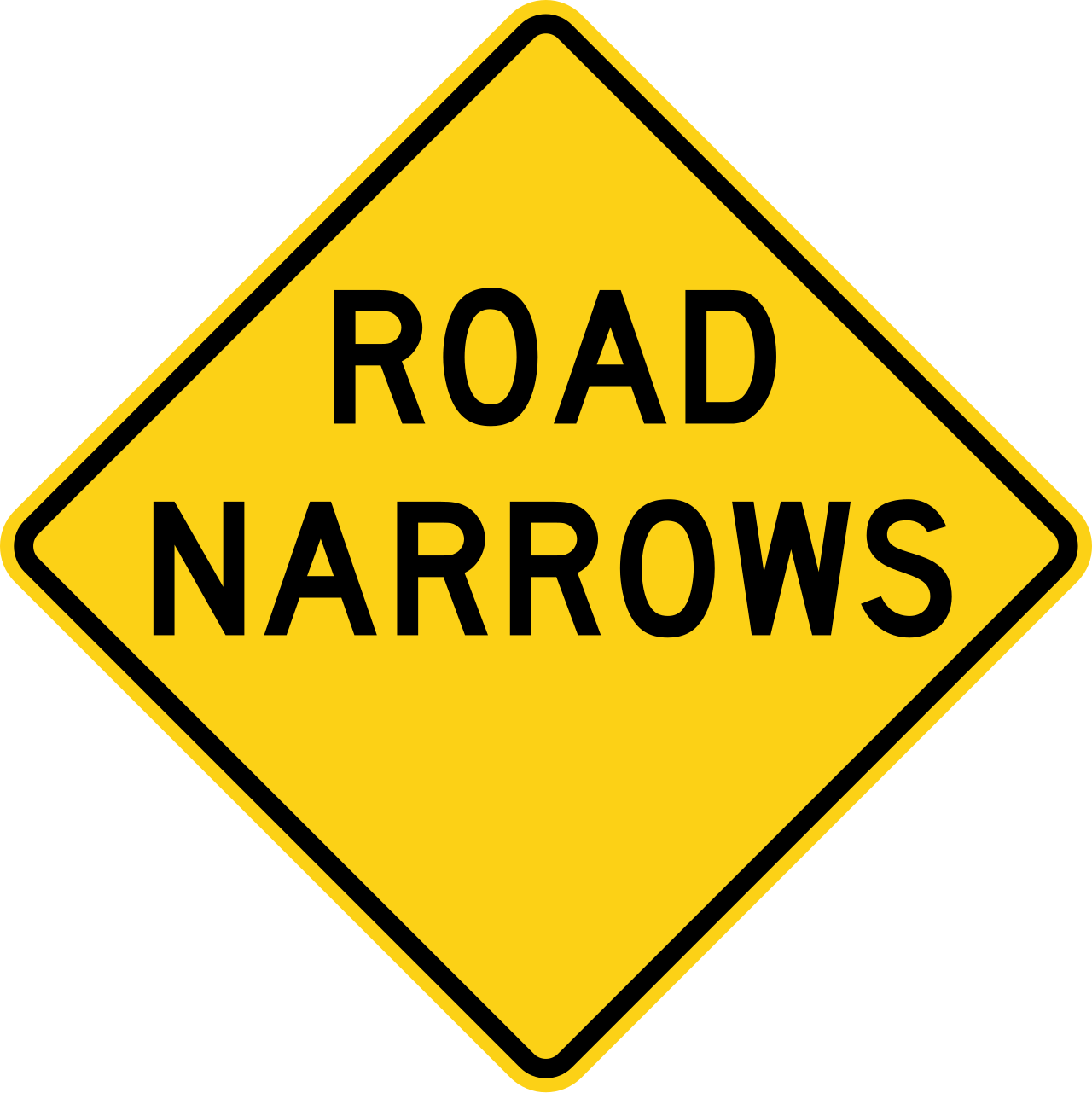
A road narrows sign warns you that the pavement ahead suddenly gets narrower. On a two-lane road, the narrow part is tight enough that you and an oncoming car can't pass each other at normal speed. When you see it, slow down, keep to the right side of your lane and be ready to share the space with oncoming traffic.
The sign comes from the federal Manual on Uniform Traffic Control Devices (MUTCD), which sets the standards for road signs in every state. That's why it's a common question on the permit test, along with the signs it's easy to mix it up with: Lane Ends, Narrow Bridge and One Lane Bridge.
What does a road narrows sign look like?
The road narrows sign, code W5-1 in the MUTCD, is a yellow diamond with a black border and the words ROAD NARROWS in black, written on two lines.
The yellow diamond is the standard look for warning signs. The New York DMV driver's manual puts it simply: warning signs "normally are yellow and diamond-shaped, with black letters or symbols." The Pennsylvania driver's manual adds that warning signs are posted before the condition, so you have time to see what's ahead and react.
Sometimes you'll see a smaller yellow plaque under the sign with a speed on it. That's an Advisory Speed plaque (W13-1P). The MUTCD allows it with the road narrows sign to show the recommended speed through the narrow section.
For the full family of yellow diamond signs, see Warning Signs: What Yellow Road Signs Mean. For every sign type, including regulatory and guide signs, see Road Sign Meanings.
When is a road narrows sign used?
The current MUTCD (the 11th Edition) covers this sign in Section 2C.17. The rule is specific. The sign should be used ahead of a transition on two-lane roads where the pavement width is reduced abruptly, to a width where vehicles traveling in opposite directions can't get through the narrow part at the same time without slowing down.
So the sign isn't about losing a lane in your direction. It's about the whole road getting squeezed, usually on a two-lane, two-way road. Both lanes still exist, but there's less room in each of them, and often less or no shoulder.
A few more details from the same section:
- Small local streets can skip it. The sign may be left off low-volume local streets with speed limits of 30 mph or less.
- Extra warning is allowed. Road crews can add object markers and delineators (the reflective posts and markers along the edge of the road) to make the narrowing easier to see.
- A speed may be posted. As mentioned above, an Advisory Speed plaque can show the recommended speed.
You may also notice the pavement markings change before the narrow spot. The New York driver's manual explains that an edge line that angles toward the center of the road shows that the road is narrower ahead.
How is a road narrows sign different from a lane ends sign?
This is the mix-up that shows up most on tests. Here's the difference:
- Road Narrows (W5-1): The whole road gets narrower. Usually a two-lane road with traffic going both ways. You keep your lane, but it's tighter, and oncoming cars are closer.
- Lane Ends (W4-2): One lane in your direction ends, so drivers in that lane have to merge into the lane next to them. The MUTCD's 2009 sign figures describe it as a diamond with a solid line on one side and a line on the other side that slants inward, with a short dashed lane line between them. It covers Lane Ends signs in Section 2C.47.
- RIGHT (LEFT) LANE ENDS (W9-1): A word version of the same warning. The MUTCD says it may be placed before the Lane Ends sign to give extra warning that a lane is ending and a merge will be required.
- LANE ENDS MERGE LEFT (W9-2): Another word sign for the same situation, telling you which way to merge.
The Pennsylvania driver's manual explains the lane ends signs this way: they tell you one lane on a multi-lane roadway will end ahead. If the right lane is ending, traffic in that lane must merge left.
A simple way to remember it: road narrows means less room, lane ends means fewer lanes.
There's also a third, less common sign. The Single-Lane Transition sign (W4-8), which may have a LANES MERGE (W9-4) sign before it, warns that two lanes going the same way both merge into one, with each lane having to merge. The MUTCD covers it in Section 2C.48.
How is it different from narrow bridge and one lane bridge signs?
These signs are in the same group of the MUTCD as road narrows, and they look alike because all three are yellow diamonds with words only.
- NARROW BRIDGE (W5-2): Warns of a bridge or culvert ahead where the roadway is narrower than the lanes leading up to it. There's also a NARROW UNDERPASS (W5-2a) version. The MUTCD covers them in Section 2C.18. The Pennsylvania driver's manual says each lane on the bridge or underpass becomes narrower and there generally is no shoulder.
- ONE LANE BRIDGE (W5-3): Warns that only one vehicle can cross at a time. The MUTCD says it should be used on two-way roads ahead of a bridge or culvert with a roadway clearance of less than 16 feet, among other conditions. There's also a ONE LANE UNDERPASS (W5-3a) version. They're in Section 2C.19, which also allows STOP or YIELD signs at these spots.
- ROAD NARROWS (W5-1): The road itself narrows, not just a bridge. Both directions still have room to pass, but not at full speed.
Put simply: narrow bridge means a tight bridge, one lane bridge means take turns, and road narrows means the road itself gets tighter.
What should you do when you see a road narrows sign?
The sign is there so you can prepare before you reach the narrow part. Here's what to do:
- Slow down. The whole point of the sign, according to the MUTCD, is that opposing vehicles can't pass through the narrow section without reducing speed. If there's an Advisory Speed plaque, use that speed as your guide.
- Keep to the right side of your lane. Less road width means oncoming cars will be closer than usual. Stay in your lane and don't drift toward the center line.
- Watch for oncoming traffic, especially large vehicles. The Pennsylvania driver's manual gives this advice for narrow bridges and underpasses, and it fits narrow roads too: keep your vehicle in your lane, and if an oncoming driver has a wide vehicle or is partly in your lane, wait until they clear the area.
- Watch the edge of the road. Shoulders may shrink or disappear, and you may see object markers or reflective posts marking the narrow spot. Don't plan on using the shoulder.
- If you need to change lanes, do it the right way. On a multi-lane road where the narrowing makes you move over, follow the steps in the California Driver's Handbook: check your mirrors, signal, check your blind spots, look over your shoulder and make sure there's enough space in the next lane.
- Keep a space cushion. The California handbook recommends leaving three seconds of space between you and the vehicle ahead when merging into highway traffic. Extra space gives you time to react if the car ahead brakes in the narrow section.
If you have to merge because a lane is ending (a Lane Ends sign, not road narrows), the same mirror and signal steps apply. For a full walkthrough, see Merging Onto a Highway: How to Do It Safely, Even With No Gap.
Is a road narrows sign a construction sign?
Not necessarily. The yellow ROAD NARROWS sign in MUTCD Chapter 2C is a regular warning sign for a spot where the road is built narrower. Work zones have their own signs and rules, covered in Construction Zone Signs: Flagger Ahead, Road Work and More.
How does the road narrows sign show up on the permit test?
Permit tests include road sign questions, so it helps to be ready for questions like these:
- "What does this sign mean?" The answer is that the road ahead becomes narrower. Not that a lane ends, and not that the road becomes one lane.
- "What should you do?" Slow down, stay in your lane and watch for oncoming traffic.
- Telling look-alike signs apart. Knowing how Road Narrows differs from Lane Ends, Narrow Bridge and One Lane Bridge helps you pick the right answer.
Word-only signs like ROAD NARROWS are easy to answer if you read them carefully. The harder questions are the symbol signs, like Lane Ends (W4-2), where you have to know what the lines mean.
Two related signs that also deal with traffic going both ways are covered in Two-Way Traffic Sign: What It Means and Divided Highway Sign: Begins vs. Ends, Explained. To see what else is on the exam, read What Questions Are on the Permit Test? Format, Topics and Examples.
The best way to get comfortable with signs that look alike is to see them over and over. You can use our practice tests to study for your permit test.
Quick recap
- Road narrows (W5-1): The road gets narrower. Slow down, keep right, watch for oncoming traffic.
- Lane ends (W4-2, W9-1, W9-2): A lane in your direction ends. Check mirrors, signal and merge.
- Narrow bridge (W5-2): A bridge or culvert ahead is tighter than the road, usually with no shoulder.
- One lane bridge (W5-3): Only one vehicle fits at a time. Be ready to yield.
Sources
- MUTCD 11th Edition, Chapter 2C: Warning Signs and Object Markers (FHWA)
- MUTCD 2009 Edition, Chapter 2C: Warning Signs and Object Markers (FHWA)
- MUTCD 2009 Edition, Figure 2C-5: Miscellaneous Warning Signs (FHWA)
- MUTCD 2009 Edition, Figure 2C-8: Merging and Passing Signs and Plaques (FHWA)
- New York State Driver's Manual, Chapter 4: Traffic Control (New York DMV)
- Pennsylvania Driver's Manual: Signs (PennDOT Driver and Vehicle Services)
- California Driver's Handbook: Navigating the Roads (California DMV)
Free permit practice test for your state
Ready to check what you know? Take a free 10-question test from your state's driver handbook, with every answer explained. No sign-up needed. See questions and pass marks for every state.
- Alabama
- Alaska
- Arizona
- Arkansas
- California
- Colorado
- Connecticut
- Delaware
- Florida
- Georgia
- Hawaii
- Idaho
- Illinois
- Indiana
- Iowa
- Kansas
- Kentucky
- Louisiana
- Maine
- Maryland
- Massachusetts
- Michigan
- Minnesota
- Mississippi
- Missouri
- Montana
- Nebraska
- Nevada
- New Hampshire
- New Jersey
- New Mexico
- New York
- North Carolina
- North Dakota
- Ohio
- Oklahoma
- Oregon
- Pennsylvania
- Rhode Island
- South Carolina
- South Dakota
- Tennessee
- Texas
- Utah
- Vermont
- Virginia
- Washington
- West Virginia
- Wisconsin
- Wyoming