

Do Not Enter Sign: What It Means and What to Do
A Do Not Enter sign means you may not drive onto that road or ramp from where you are. Here's what it looks like, where it's used and what to do if you pass one.
Bianca Galvan
Product & Content at GetMyPermit
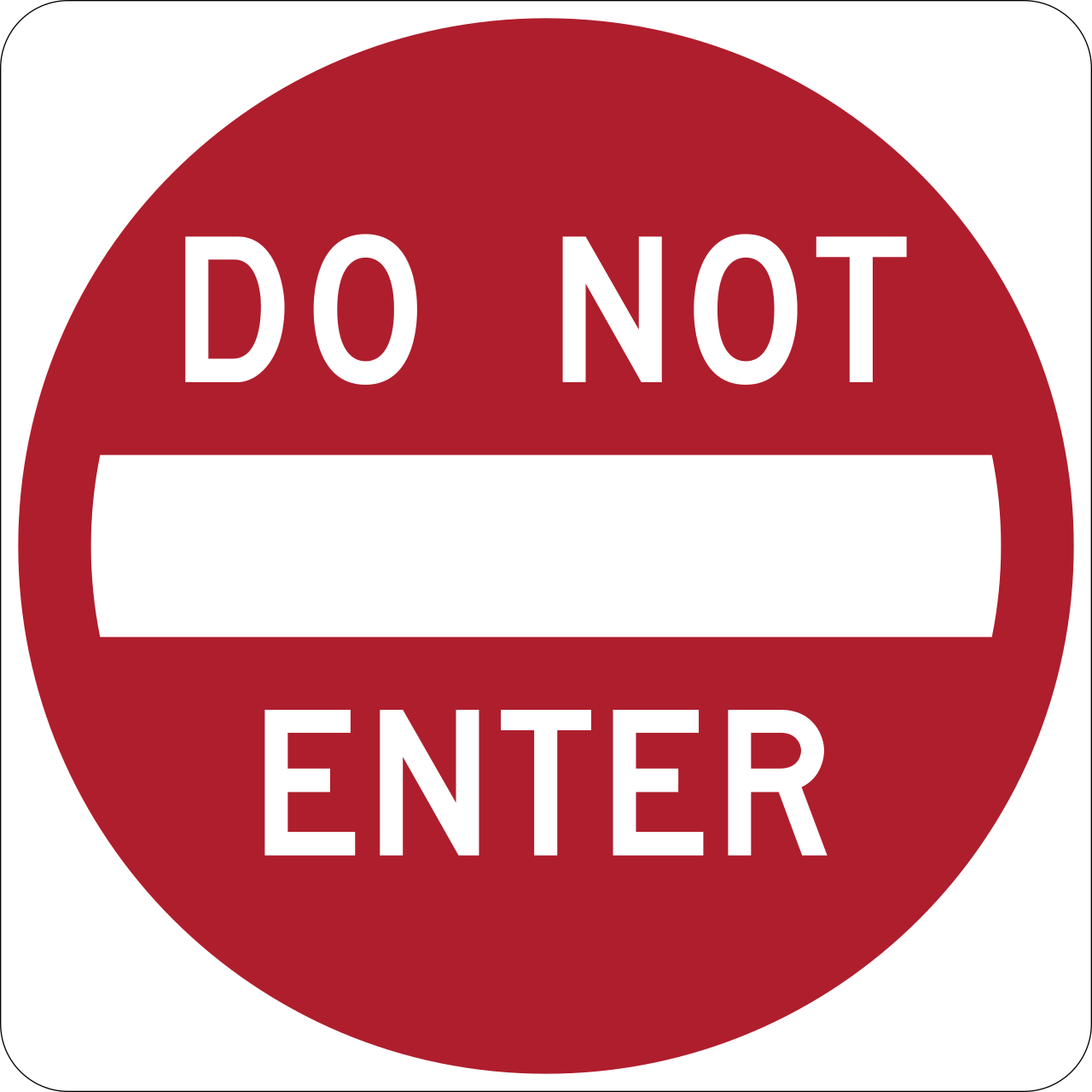
A Do Not Enter sign means you may not drive onto that road or ramp in the direction you're heading. Traffic on the other side is coming toward you. If you pass one by mistake, slow down, pull over when it's safe and turn around.
It's one of the most common signs on the permit test, and one of the most important on the road, because ignoring it puts you head-on with oncoming traffic. Here's how to recognize it, where you'll see it and how it works with the Wrong Way and One Way signs.
What does a Do Not Enter sign mean?
The Do Not Enter sign is a regulatory sign, which means it's a rule you must obey, not a suggestion. The California Driver's Handbook puts it simply: Do Not Enter means do not enter the road or ramp where the sign is posted.
The Pennsylvania Driver's Manual adds the key detail: when you see this sign, do not drive onto that street or ramp in the direction you are heading. The road itself isn't closed. Other drivers are using it legally, just in the opposite direction.
In the federal rulebook for US road signs, the Manual on Uniform Traffic Control Devices (MUTCD), the sign is called R5-1. The MUTCD says it shall be used at specific places where traffic is not allowed to enter, which we'll cover below.
For the bigger picture of rule signs, see our guide to regulatory signs.
What does the Do Not Enter sign look like?
The MUTCD describes the R5-1 as a square white sign with a solid red disc in the middle. The words "DO NOT" and "ENTER" appear in white, above and below a thick horizontal white bar inside the red circle.
A few things to remember for your test:
- Shape: square. In the MUTCD, rectangles (including squares) are the shape used for the regulatory series of signs.
- Colors: red and white. The Virginia Driver's Manual explains that red used with white conveys stop, yield, "do not" and "no." It lists Do Not Enter and Wrong Way signs as examples, along with Stop and Yield signs.
- Size: larger roads get larger signs. The MUTCD sizes table lists 30 x 30 inches for a single-lane conventional road, 36 x 36 inches for multi-lane roads and expressways, and 48 x 48 inches on freeways.
If a Do Not Enter sign has a strip of reflective material running down its post, the MUTCD requires that strip to be red. A flashing red Stop Beacon can also be added to a Do Not Enter sign to make it more noticeable.
Not sure how shapes and colors work across all signs? Our post on road sign meanings breaks it down.
Where will you see a Do Not Enter sign?
According to the current MUTCD (11th Edition, Section 2B.46), the Do Not Enter sign shall be used at these locations:
- Where a two-way road becomes a one-way road. You'll see it facing you at the point where you'd be entering the one-way section against traffic.
- Where a freeway or highway exit ramp meets a crossroad. This keeps drivers on the crossroad from turning up the off-ramp by mistake.
- Where a channelized or turning roadway meets a two-way undivided crossroad. Think of a separate right-turn lane that only flows one way.
- Where a road crosses a divided highway and the crossing works as two separate intersections. Each side of the divided highway is effectively a one-way road. (A low-speed urban divided street can be an exception.)
The MUTCD also says the sign should be added anywhere wrong-way movements are a problem. It should also go where roads meet at an angle that makes One Way signs alone hard to notice.
Where it's placed matters too. The MUTCD says the sign should be directly in view of a driver at the point where they could wrongly enter a divided highway, one-way road or ramp, facing the traffic that might enter the wrong way. A second Do Not Enter sign may be added, especially where traffic approaches from a crossing road. If the sign would be visible to traffic it doesn't apply to, it should be turned away or shielded from that traffic.
The Pennsylvania manual sums it up for drivers: the Do Not Enter sign is put at the beginning of one-way streets and ramps.
How does the Do Not Enter sign work with the Wrong Way sign?
The Pennsylvania manual says the Do Not Enter and Wrong Way signs "work as a team."
The Wrong Way sign (MUTCD R5-1a) is a horizontal red rectangle with a white border and the words "WRONG WAY" in white on two lines. It's the backup to the Do Not Enter sign:
- The Do Not Enter sign sits at the entrance, where you might turn onto the road or ramp the wrong way.
- The Wrong Way sign sits farther down the one-way road or ramp, on the same side of the road. It's there to catch your attention if you already missed the first sign and turned in by accident.
The MUTCD lets road agencies use a Wrong Way sign to supplement a Do Not Enter sign where a crossroad meets a one-way road in a way that doesn't physically prevent wrong-way entry. If it's used, the MUTCD says it should be placed farther from the crossroad than the Do Not Enter sign.
So if you see a Wrong Way sign facing you, you've already passed the point where you should have stopped. You're driving against traffic.
How does it pair with One Way signs?
The One Way sign (MUTCD R6-1 or R6-2) tells you which direction traffic is allowed to move. The Virginia manual says traffic flows only in the direction of the arrow. The Pennsylvania manual warns that if you turn onto a one-way street traveling in the opposite direction, you are likely to get into a head-on collision. Our post on the one way sign covers how to turn onto a one-way street correctly.
The three signs give you the full message from different angles:
- One Way: this is the direction traffic moves.
- Do Not Enter: don't come in from here.
- Wrong Way: you're already going the wrong direction.
The MUTCD places One Way signs parallel to the one-way street at the alleys and roads that cross it. At a road crossing a divided highway that works as two separate intersections, One Way signs go on the near right and far left corners of each intersection.
For more on crossing and turning onto divided roads, see our post on the divided highway sign. If you're comparing it with signs that show traffic moving both ways, read about the two-way traffic sign.
Why are Do Not Enter signs used on freeway exit ramps?
Exit ramps are one of the places where wrong-way entry is most dangerous: a driver who turns up an off-ramp ends up on a freeway, facing high-speed traffic.
That's why the MUTCD (Section 2B.48) requires a full set of signs where an exit ramp meets a crossroad in a way that a driver could enter the wrong way by accident:
- At least one One Way sign for each direction of travel on the crossroad, where the exit ramp meets it.
- At least one Do Not Enter sign, placed near the end of the exit ramp so a driver starting to turn in from the crossroad can see it clearly.
- At least one Wrong Way sign on the exit ramp, facing anyone traveling in the wrong direction.
Road agencies may add more. Options in the MUTCD include extra One Way and Wrong Way signs, lane-use arrows on the pavement, and wrong-way arrow markings. They also include raised pavement markers that show red to wrong-way drivers and white to everyone else.
That ties directly to a tip in the California Driver's Handbook: if you are driving at night, you'll know you're going the wrong way if the road reflectors shine red in your headlights.
When you're getting on the freeway, make sure you're on the entrance ramp, not the exit. Our guide to merging onto a highway covers what to do once you're on the right ramp.
What should you do if you pass a Do Not Enter sign by mistake?
It happens, especially at night, in an unfamiliar area or at a confusing intersection. Here's what official state handbooks say to do:
- Slow down right away. The Virginia Driver's Manual says that if you drive past Do Not Enter or Wrong Way signs, you're going in the wrong direction and could get into a head-on crash. It says to immediately slow down, pull over and cautiously turn around.
- Pull over. Get out of the path of oncoming traffic as soon as you safely can.
- Turn around only when it's safe. The California Driver's Handbook says: when it is safe, back out or turn around.
The key words in both handbooks are "safe" and "cautiously." Don't make a sudden move into oncoming traffic. Get out of the way first, then turn around.
Rules for backing up on specific roads, like freeways, can vary. Check your own state's driver handbook for the details that apply where you drive.
How does the Do Not Enter sign show up on the permit test?
Expect questions like these on your written test:
- Identify the sign. You may see a picture of a red circle with a white bar and be asked what it means. The answer: you may not enter the road or ramp from that direction.
- Shape and color. You may be asked which colors mean "do not" or "no" (red and white), or which shape regulatory signs use (rectangle or square).
- Do Not Enter vs. Wrong Way. You may be asked which sign comes first and where the Wrong Way sign is placed (farther down the one-way road or ramp).
- Wrong-way driving at night. A California-style question might ask what red road reflectors in your headlights mean (you're going the wrong way).
- What to do. You may be asked what to do if you enter a road against traffic: slow down, pull over and turn around when it's safe.
Every state builds its test from its own handbook, so read the signs section of yours. You can see the exact wording for your state on our California, Pennsylvania and Virginia practice test pages.
To get comfortable with signs before test day, try practice tests to study for your permit test. For more on the format, see what questions are on the permit test, and if you're short on time, here's how to study for the permit test.
Sources
- Manual on Uniform Traffic Control Devices, 11th Edition, Chapter 2B: Regulatory Signs (FHWA)
- Manual on Uniform Traffic Control Devices, 11th Edition, Chapter 2A: General (FHWA)
- Figure 2B-11 Long Description, MUTCD 2009 Edition (FHWA)
- California Driver's Handbook, Section 7: Laws and Rules of the Road (California DMV)
- Pennsylvania Driver's Manual, Chapter 2: Signs (Pennsylvania Driver and Vehicle Services)
- Virginia Driver's Manual, Section 2: Signals, Signs and Pavement Markings (Virginia DMV)
Free permit practice test for your state
Ready to check what you know? Take a free 10-question test from your state's driver handbook, with every answer explained. No sign-up needed. See questions and pass marks for every state.
- Alabama
- Alaska
- Arizona
- Arkansas
- California
- Colorado
- Connecticut
- Delaware
- Florida
- Georgia
- Hawaii
- Idaho
- Illinois
- Indiana
- Iowa
- Kansas
- Kentucky
- Louisiana
- Maine
- Maryland
- Massachusetts
- Michigan
- Minnesota
- Mississippi
- Missouri
- Montana
- Nebraska
- Nevada
- New Hampshire
- New Jersey
- New Mexico
- New York
- North Carolina
- North Dakota
- Ohio
- Oklahoma
- Oregon
- Pennsylvania
- Rhode Island
- South Carolina
- South Dakota
- Tennessee
- Texas
- Utah
- Vermont
- Virginia
- Washington
- West Virginia
- Wisconsin
- Wyoming