

Pedestrian Crossing Sign: What It Means and What to Do
A pedestrian crossing sign warns that people may cross ahead or right here. Slow down, watch for walkers and yield or stop for anyone in the crosswalk.
Bianca Galvan
Product & Content at GetMyPermit
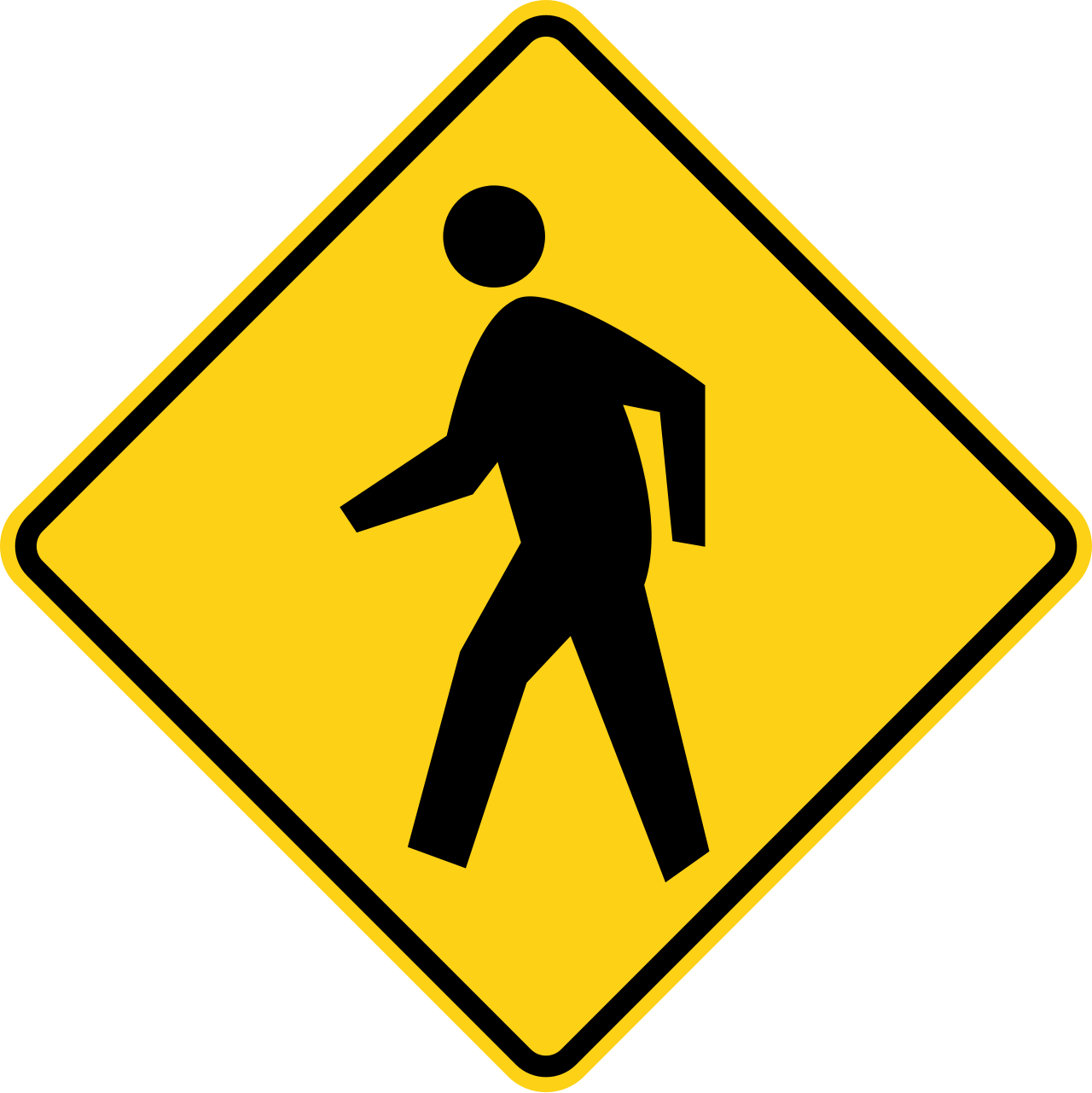
A pedestrian crossing sign is a diamond-shaped warning sign with a walking person on it. It tells you that people on foot may be crossing the road, either up ahead or right at the sign. When you see it, slow down, look for pedestrians and be ready to yield or stop for anyone in the crosswalk.
The sign is official: the federal Manual on Uniform Traffic Control Devices (MUTCD) calls it the Pedestrian Crossing sign and gives it the code W11-2. The MUTCD is the national standard for road signs in the US, so the sign looks and works the same way across states.
What does the pedestrian crossing sign look like?
The W11-2 sign is a warning sign, so it follows the warning sign design: a diamond shape with a black symbol and a black border. The symbol is a person walking.
You'll see it in two colors:
- Yellow with a black symbol, the standard warning sign color.
- Fluorescent yellow-green with a black symbol. The MUTCD allows this brighter background for the pedestrian crossing sign and its plaques because it stands out more.
Both colors mean exactly the same thing. The bright yellow-green version is not a "stronger" rule; it is just easier to spot. If you want a refresher on why warning signs are shaped and colored the way they are, see our guide to warning signs and our post on road sign meanings.
What does the sign mean according to the MUTCD?
The MUTCD groups the pedestrian crossing sign with other "Non-Vehicular Warning" signs (like deer, cattle and equestrian signs) in Section 2C.55 of the 11th Edition. It says these signs may be used to alert road users in advance of places where unexpected entries into the roadway might occur, or where pedestrians, animals or riders may share the road.
In plain terms: the sign marks a spot where someone on foot might step into the street, often somewhere you wouldn't expect it, like the middle of a block, a trail crossing or a crossing near a park.
The MUTCD also says the crossing spot may be marked with crosswalk lines on the pavement. So the sign and the painted crosswalk often go together, but not always.
What do the arrow and "AHEAD" plaques mean?
The small sign mounted under the pedestrian crossing sign tells you where the crossing is. This is the part people mix up most on the permit test.
Advance sign: AHEAD or a distance
When the sign has a plaque that says AHEAD (code W16-9P) or a distance like 500 FEET, the crossing is coming up but you are not there yet. The MUTCD describes these plaques as giving road users advance notice. This is your cue to slow down and start scanning the sidewalks and road edges.
Sign at the crossing: the downward arrow
When the sign has a plaque with an arrow pointing diagonally down (code W16-7P), the crossing is right there, at the sign. The MUTCD (Section 2C.63) explains that the arrow points diagonally down toward the roadway, to the left or right depending on which side of the road the sign is on. In other words, the arrow is pointing at the crosswalk.
So on many streets you'll see this sequence:
- A pedestrian crossing sign with an AHEAD plaque: get ready.
- A pedestrian crossing sign with a downward arrow: the crosswalk is here.
The MUTCD also allows the pedestrian crossing sign to hang overhead above the lanes at the crosswalk.
Other signs you may see nearby
At some crosswalks, especially on multi-lane roads, you may also see a white regulatory sign that says Yield Here To Pedestrians or Stop Here For Pedestrians, placed before the crosswalk. The MUTCD lets road agencies pair it with an advance pedestrian crossing sign on the approach to the same crosswalk. Unlike the yellow warning sign, that white sign tells you exactly where to yield or stop. Our post on regulatory signs explains the difference between signs that warn and signs you must obey.
The MUTCD also allows a warning beacon (a flashing yellow light) with the sign, sometimes with a WHEN FLASHING plaque, to show when pedestrians are likely to be crossing.
What is the school crossing sign, and how is it different?
The school version looks different on purpose. It is the School sign (MUTCD code S1-1): a five-sided sign, shaped like a house, with two children walking on it. The MUTCD (Part 7) requires school warning signs to use the fluorescent yellow-green background with a black legend and border.
It works the same way as the pedestrian crossing sign:
- School Advance Crossing assembly: the S1-1 sign with an AHEAD plaque or an XX FEET plaque. A school crossing is coming up.
- School Crossing assembly: the S1-1 sign with the downward diagonal arrow (W16-7P). The MUTCD says it is placed at the school crossing, or as close to it as possible, to show where the crossing is.
The MUTCD limits the School Crossing assembly to crossings next to schools and crossings on established school walking routes. The same S1-1 sign is also used to mark where a school zone begins.
The California Driver Handbook sums up what the five-sided sign means for you: you are near a school, so drive slowly and stop for children in the crosswalk. California also notes that school crossings may have yellow crosswalk lines instead of white ones.
What do you have to do when you see a pedestrian crossing sign?
The sign itself is a warning, not an order. But your state's crosswalk law still applies, and the handbooks below are clear that pedestrians in crosswalks come first. Here is what to do:
- Slow down as soon as you see the sign, especially if it has an AHEAD plaque.
- Scan both sides of the road for people waiting to cross, walking toward the curb or already in the street.
- Yield or stop for anyone in the crosswalk, and let them finish crossing.
- Don't pass a vehicle that is stopped at the crosswalk. It may be stopped for someone you can't see.
- Wait until the pedestrian is safely out of your path before you go.
How states word the rule varies a little. Here is what a few official handbooks and state agencies say.
California
The California Driver Handbook says pedestrians have the right-of-way in marked or unmarked crosswalks. When a pedestrian is crossing, you must use caution, reduce your speed or stop so they can safely finish crossing. It also says:
- Not all crosswalks are marked.
- At crosswalks with flashing lights, look for pedestrians and be prepared to stop whether or not the lights are flashing.
- Do not pass a vehicle stopped at a crosswalk, because you may not see the person crossing.
- Pedestrians using guide dogs or white canes have the right-of-way at all times.
New York
The New York Driver's Manual says pedestrians crossing legally at marked or unmarked crosswalks always have the right-of-way. You must reduce your speed or, if needed, come to a complete stop. The manual also says to never pass vehicles stopped at a crosswalk, since people may be crossing where you can't see them. When turning, you must also yield to pedestrians in the crosswalks on your left or right.
Texas
The Texas Department of Transportation tells Texas drivers to stop and yield for pedestrians in crosswalks, and to yield to pedestrians when turning. It also warns that stopped vehicles can block your view of pedestrians, so be careful when passing them.
Your state
The details (for example, whether you must wait until the person has crossed your whole side of the road or the entire street) depend on your state's law. Check your state's driver handbook before your test. Our guide to right of way rules covers the general order of who goes first.
Does the sign mean pedestrians always have the right-of-way?
Not quite. The sign doesn't create a right-of-way rule on its own. It warns you that a crossing is there. The right-of-way comes from your state's crosswalk law, which, in the handbooks above, gives pedestrians priority in marked and unmarked crosswalks.
Two points that often show up on permit tests:
- Unmarked crosswalks count. California and New York both say pedestrians have the right-of-way in unmarked crosswalks too, not only where lines are painted.
- No sign doesn't mean no pedestrians. Pedestrians can cross at intersections and other places without a warning sign. The sign is an extra heads-up, not the only place you need to watch.
Where are you most likely to see this sign?
Because the MUTCD describes these signs as alerts for places where unexpected entries into the roadway might occur, you'll usually find them where drivers might not expect people on foot, such as:
- Mid-block crosswalks between intersections
- Trail and path crossings
- Crossings near parks, shopping areas or transit stops
- Roundabouts and channelized right-turn lanes with a crosswalk before the yield point (the 11th Edition specifically allows the sign there)
Near schools, you'll see the five-sided school sign instead.
How does this sign show up on the permit test?
Questions about this sign tend to be simple, but the answer choices can be tricky. Expect things like:
- "What does this sign mean?" Correct answer: pedestrian crossing, watch for people crossing.
- "What should you do when you see this sign?" Correct answer: slow down, watch for pedestrians and be ready to stop.
- "What does the arrow under the sign mean?" Correct answer: the crossing is at that location.
- "What shape is the school sign?" Correct answer: five-sided (pentagon).
- "Can you pass a car stopped at a crosswalk?" Correct answer: no.
A wrong answer you'll often see is "pedestrians must yield to cars here." That's backwards. Another is confusing the walking-person sign with the yield sign, which is a red-and-white triangle.
The easiest way to get these right is to see the signs many times before test day. Our permit practice tests let you study road signs and right-of-way questions in the same style as the real test. For more on what to expect, read what questions are on the permit test.
Quick recap
- Diamond with a walking person, yellow or fluorescent yellow-green: pedestrian crossing (W11-2).
- AHEAD or distance plaque: the crossing is coming up.
- Downward diagonal arrow: the crossing is right here.
- Five-sided sign with two children: school zone or school crossing (S1-1).
- What to do: slow down, scan, yield or stop for anyone in the crosswalk, and never pass a car stopped at a crosswalk.
Sources
- Manual on Uniform Traffic Control Devices, 11th Edition (FHWA)
- MUTCD 11th Edition, Chapter 2C: Warning Signs and Object Markers (FHWA)
- MUTCD 11th Edition, Part 7: Traffic Control for School Areas (FHWA)
- MUTCD 2009 Edition, Chapter 2C: Warning Signs and Object Markers (FHWA)
- California Driver Handbook: Laws and Rules of the Road (California DMV)
- Chapter 5: Intersections and Turns (New York DMV)
- Chapter 11: Sharing the Road (New York DMV)
- Pedestrian Safety Campaign (Texas Department of Transportation)
Free permit practice test for your state
Ready to check what you know? Take a free 10-question test from your state's driver handbook, with every answer explained. No sign-up needed. See questions and pass marks for every state.
- Alabama
- Alaska
- Arizona
- Arkansas
- California
- Colorado
- Connecticut
- Delaware
- Florida
- Georgia
- Hawaii
- Idaho
- Illinois
- Indiana
- Iowa
- Kansas
- Kentucky
- Louisiana
- Maine
- Maryland
- Massachusetts
- Michigan
- Minnesota
- Mississippi
- Missouri
- Montana
- Nebraska
- Nevada
- New Hampshire
- New Jersey
- New Mexico
- New York
- North Carolina
- North Dakota
- Ohio
- Oklahoma
- Oregon
- Pennsylvania
- Rhode Island
- South Carolina
- South Dakota
- Tennessee
- Texas
- Utah
- Vermont
- Virginia
- Washington
- West Virginia
- Wisconsin
- Wyoming