

One Way Sign: What It Means and How to Turn Onto a One-Way Street
A ONE WAY sign means all traffic on that street moves in the arrow's direction. Learn how to read it and which lane to use when you turn onto a one-way street.
Bianca Galvan
Product & Content at GetMyPermit
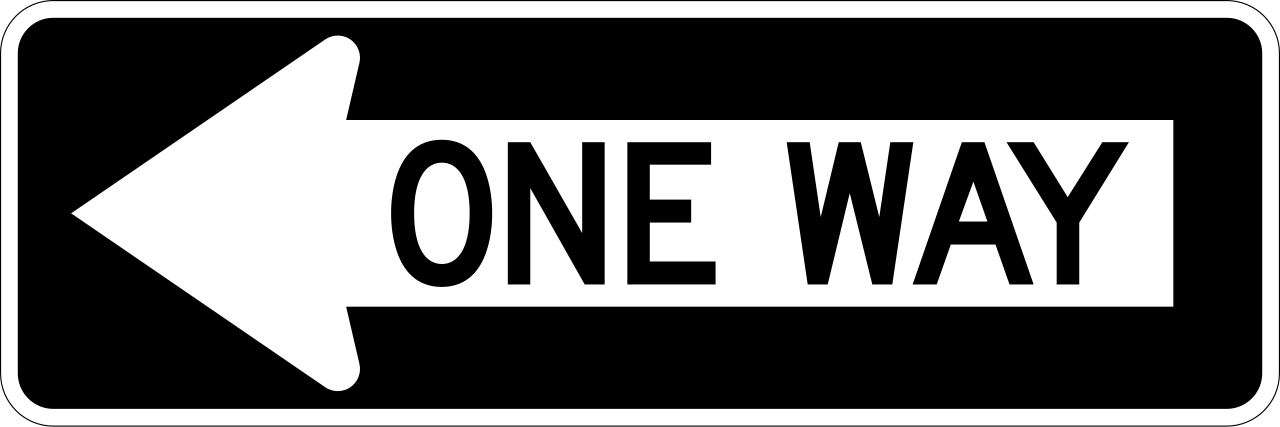
A ONE WAY sign means traffic on that street may travel in only one direction: the way the arrow points. If you turn onto that street, you must turn so you end up moving with the arrow, never against it.
That sounds simple, but one-way streets are where a lot of new drivers get turns wrong on the road test. The tricky part isn't the sign. It's knowing which lane to start your turn from and which lane to end it in. This guide covers both.
What does a ONE WAY sign look like?
The Manual on Uniform Traffic Control Devices (MUTCD), the federal standard for every road sign in the US, has two versions of the ONE WAY sign. Both are black and white rectangles, like other regulatory signs.
- R6-1 (horizontal): a wide black rectangle with a large white arrow. The words "ONE WAY" are written in black inside the arrow.
- R6-2 (vertical): a taller white rectangle with a black border. "ONE WAY" is written in black on two lines, with a black arrow below it.
They mean exactly the same thing. The arrow shows the only direction traffic is allowed to move on that street.
The MUTCD also has two related signs:
- BEGIN ONE WAY (R6-6): marks the point where a street starts carrying traffic in one direction.
- END ONE WAY (R6-7): marks the point where the one-way restriction ends and the street goes back to two-way traffic.
Because ONE WAY signs are black and white, they are regulatory signs: they tell you a law you must follow, not just a warning. You can read more about this group in our guide to regulatory signs.
What does the ONE WAY sign mean for drivers?
The MUTCD says the ONE WAY sign is used to mark streets or roadways where vehicles are allowed to travel in one direction only. For you as a driver, that means:
- You may only drive on that street in the direction of the arrow.
- If you're turning onto it, you can only turn the way the arrow points.
- If the arrow points left, a right turn onto that street would put you against traffic, which is illegal and dangerous.
Where will you see ONE WAY signs?
The MUTCD sets out where these signs go, so you know where to look:
- Side streets and alleys: ONE WAY signs are placed parallel to the one-way street at alleys and roads that cross it, so drivers coming from the side see which way traffic flows before they turn.
- Intersections without traffic lights: signs go on the near right and far left corners of the intersection. As you pull up, look at the corner on your right and the corner across the street on your left.
- Intersections with traffic lights: the signs can be placed near the traffic signal faces, often on the signal pole or the arm that holds the lights.
- Divided highways: where you cross a highway with a median, ONE WAY signs on the near right and far left corners show which way each side of the highway flows. A sign on the far right corner is also allowed.
- Roundabouts: ONE WAY signs may be placed on the central island to show the direction you travel around it.
- Freeway exit ramps: where a ramp meets a cross street, the MUTCD calls for ONE WAY signs on the cross street along with DO NOT ENTER and WRONG WAY signs, to stop drivers from going up an exit ramp the wrong way.
The MUTCD also allows an EXCEPT BICYCLES plaque under a ONE WAY sign. That means bikes may ride in both directions on that street, but cars and other vehicles may not.
How else can you tell a street is one-way?
The sign is your main clue, but pavement markings help too:
- White lines between lanes: The California Driver Handbook says a single solid white line marks lanes going in the same direction, including on one-way streets. If every lane line is white, all lanes are going your way.
- Yellow line on the left: Under the MUTCD, yellow lines mark the left edge of one-way streets and ramps. On a one-way street, the yellow line should be on your left.
You'll often see ONE WAY signs together with DO NOT ENTER and WRONG WAY signs. Our guide to the Do Not Enter sign explains what to do if you see one.
How do you turn right onto a one-way street?
Right turns work the same as on any street. Start from the right-most lane and turn into the right lane of the road you enter.
- The New York State Driver's Manual says to get as far to the right as possible as you prepare to turn and, unless signs direct otherwise, turn into the right lane of the road you enter.
- The California Driver Handbook shows a right turn from one one-way street onto another starting in the far-right lane, and says that if it's safe, you may end the turn in any lane.
Before you turn, check the ONE WAY sign. The arrow on the street you're turning onto must point to your right.
How do you turn left onto a one-way street?
There are three situations, and the starting lane changes for each.
Left turn from a two-way street onto a one-way street
- Start in the left part of your side of the road, closest to the center line. The New York manual says to approach the turn from the right half of the roadway closest to the center.
- Make the turn before you reach the center of the intersection.
- Turn into the left lane of the one-way street. New York's manual says to turn into the left lane of the road you enter. California says that if there are three or more lanes in your direction of travel, you may end your turn in any lane that is open.
Left turn from a one-way street onto a two-way street
- Start in the far-left lane of the one-way street. Both the New York and California handbooks say this.
- End the turn just to the right of the center line of the two-way street. New York says to enter the two-way road to the right of its center line, but as close as possible to it. California says to end the turn in the left lane closest to the middle of the street going in your direction, to reduce the risk of a collision.
Left turn from a one-way street onto a one-way street
- Start in the far-left lane. New York says to move into the left lane when you prepare to turn.
- Turn into the left lane of the street you enter. New York says that if the road you enter has two lanes, you must turn into its left lane. California says you may end your turn in any open lane if there are three or more lanes in your direction.
- Watch for bicyclists. California's handbook notes that bicyclists can legally use the left turn lane for their own left turns.
The simple rule to remember: when you're on a one-way street, turn from the lane on the side you're turning toward. Left turns start from the far-left lane. Right turns start from the far-right lane.
Can you turn left on red onto a one-way street?
In some states, yes, but only from one one-way street onto another one-way street.
- California: The California Driver Handbook says you may turn left against a red light when turning from a one-way street onto a one-way street. Make sure no sign prohibits the turn, and yield to other vehicles, pedestrians and bicyclists who have a green light.
- New York: The New York State Driver's Manual says you can make a left turn at a steady red light when you turn from a one-way road into another one-way road, after a full stop and yielding to oncoming traffic and pedestrians. There's an important exception: you are not allowed to turn on red in New York City unless a sign permits it.
In both states, a NO TURN ON RED sign overrides the rule. Left on red is not allowed in every state, so check your own state's driver handbook before you try it. Our guide on turning right on red covers more about turns at red lights.
If you're studying in either state, see the California permit practice test or the New York permit practice test.
What else is different on a one-way street?
A few rules change once you're on a one-way street:
- No U-turns: California's handbook lists a one-way street as a place where you should never make a U-turn.
- Passing on the right: California allows passing on the right on a one-way street, as long as it's safe.
- Pick your lane early: Since you'll turn left from the far-left lane and right from the far-right lane, move into the correct lane well before the intersection.
Will the ONE WAY sign be on the permit test?
Questions about ONE WAY signs and turning onto one-way streets are common on permit tests because they mix sign recognition with lane rules. Expect questions like:
- What does a black and white sign with an arrow and the words ONE WAY mean?
- Which lane should you start a left turn from on a one-way street?
- When can you turn left on a red light?
If you want to get comfortable with these questions, take a few practice tests to study for your permit test. You can also review the shapes and colors of every sign in our guide to road sign meanings, or check the Two-Way Traffic sign for the sign about roads with traffic in both directions.
Sources
- MUTCD 11th Edition, Chapter 2B: Regulatory Signs, Section 2B.49 ONE WAY Signs (FHWA)
- MUTCD 2009 Edition, Chapter 2B: Regulatory Signs (FHWA)
- MUTCD 2009 Edition, Figure 2B-13: DO NOT ENTER, WRONG WAY, ONE WAY and Related Signs (FHWA)
- MUTCD 2009 Edition, Chapter 3A: General, Section 3A.05 Colors (FHWA)
- California Driver Handbook, Section 6: Navigating the Roads (California DMV)
- New York State Driver's Manual, Chapter 5: Intersections and Turns (New York DMV)
- New York State Driver's Manual, Chapter 4: Traffic Control (New York DMV)
Free permit practice test for your state
Ready to check what you know? Take a free 10-question test from your state's driver handbook, with every answer explained. No sign-up needed. See questions and pass marks for every state.
- Alabama
- Alaska
- Arizona
- Arkansas
- California
- Colorado
- Connecticut
- Delaware
- Florida
- Georgia
- Hawaii
- Idaho
- Illinois
- Indiana
- Iowa
- Kansas
- Kentucky
- Louisiana
- Maine
- Maryland
- Massachusetts
- Michigan
- Minnesota
- Mississippi
- Missouri
- Montana
- Nebraska
- Nevada
- New Hampshire
- New Jersey
- New Mexico
- New York
- North Carolina
- North Dakota
- Ohio
- Oklahoma
- Oregon
- Pennsylvania
- Rhode Island
- South Carolina
- South Dakota
- Tennessee
- Texas
- Utah
- Vermont
- Virginia
- Washington
- West Virginia
- Wisconsin
- Wyoming