

Low Clearance Sign: What It Means
A low clearance sign warns that a bridge or overpass ahead has limited height. The number is the posted clearance. If you're taller, don't pass.
Bianca Galvan
Product & Content at GetMyPermit
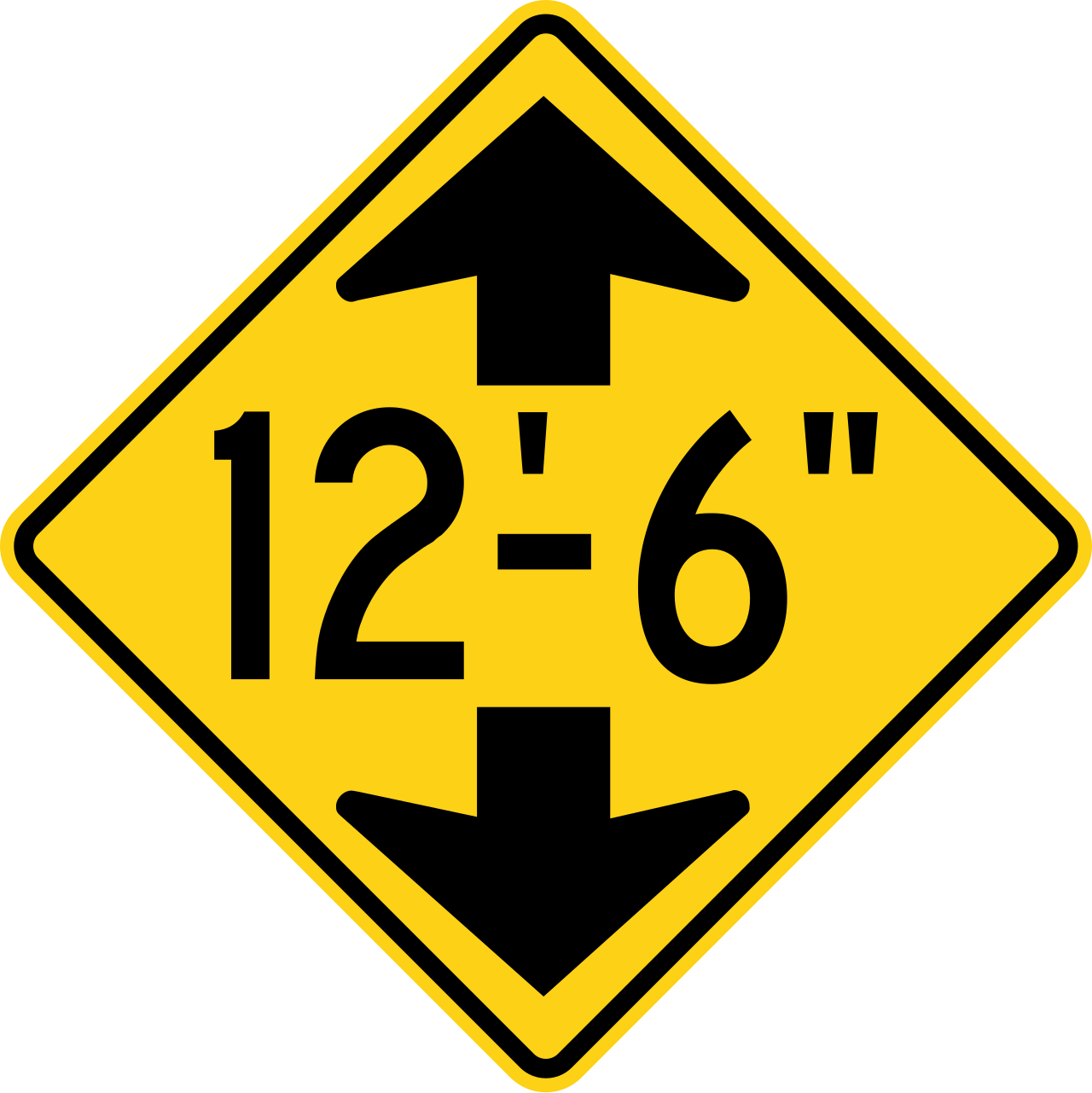
A low clearance sign warns you that a bridge, overpass or other structure ahead has limited space overhead. The number on the sign, such as 12'-6", is the posted vertical clearance. If your vehicle, plus anything on its roof or anything you're towing, is taller than that number, don't drive under it.
The sign is part of the federal Manual on Uniform Traffic Control Devices (MUTCD), so it looks the same in every state. Here's how to read it, where the number comes from and what to do when you see one.
What does a low clearance sign look like?
The main low clearance sign is a yellow diamond with a black border and black symbols. That's the standard look for warning signs: MUTCD Section 2C.02 says warning signs are diamond-shaped with a black legend and border on a yellow background, unless a specific sign is designated otherwise.
On the low clearance sign you'll see:
- An arrow pointing up at the top of the diamond.
- A height in feet and inches across the middle. The MUTCD example reads 12'-6".
- An arrow pointing down at the bottom.
An easy way to remember it: the two arrows mark the top and bottom of the space you have to fit through, and the number is the size of that space.
For the full family of yellow diamond signs, see Warning Signs: What Yellow Road Signs Mean. For every sign type, including regulatory and guide signs, see Road Sign Meanings.
What are the MUTCD codes for low clearance signs?
The current MUTCD, the 11th Edition (December 2023), covers low clearance signs in Section 2C.25. It lists three signs:
- W12-2, Low Clearance Advance. The yellow diamond with the up and down arrows and the height. It goes ahead of the structure.
- W12-2a, Low Clearance Overhead. A yellow horizontal rectangle mounted on the structure itself. The MUTCD example reads 14 FT 4 IN.
- W12-2b, Low Clearance Overhead (lane). A wider yellow rectangle with a down arrow between the feet and the inches (the example reads 14 FT, a down arrow, 4 IN). It hangs over a specific lane or shoulder.
The 11th Edition doesn't list a separate W12-2P plaque. In the older 2009 MUTCD, this topic was Section 2C.27 and included only the W12-2 and W12-2a signs. The W12-2b lane sign was added in the 11th Edition.
When does a road need a low clearance sign?
The MUTCD sets a firm rule for the advance sign. Under Section 2C.25, the W12-2 sign shall be used to warn of vertical clearances less than 14 feet 6 inches, or less than 12 inches above the state's statutory maximum vehicle height, whichever is greater.
That second part matters because each state sets its own legal maximum vehicle height. In a state with a higher legal limit, the threshold for posting a sign is higher too.
The 2009 MUTCD only used the "12 inches above the statutory maximum" test. The 11th Edition added the 14'-6" floor.
The MUTCD also gives guidance on where these signs go:
- At the last place to turn around. A W12-2 sign with a distance plaque should also be placed at the nearest intersecting road or wide spot where a vehicle can detour or turn around.
- On side roads and exits. If the low clearance is on an intersecting road or off a freeway or expressway exit, a rectangular warning sign with a word message should be used instead of the W12-2 diamond.
- On the structure. The W12-2a or W12-2b overhead signs may be installed on the structure to back up the advance sign. If the structure is too narrow for them, a W12-2 diamond may be mounted on it instead.
- On arches. Where the clearance changes a lot across the structure, like under an arch, two or more overhead signs should show the clearance over the low parts of the road.
- Over one lane. If a W12-2b sign is used because the posted clearance doesn't apply to the whole structure, it must be placed over the lane or shoulder with the low clearance.
What does the number on a low clearance sign mean?
The number is the posted clearance: the height of the opening, rounded down. MUTCD Section 2C.25 says the sign should show the actual clearance to the nearest 1 inch, without going over the actual clearance.
There's one more adjustment. In areas where temperature changes cause frost action, the MUTCD says a reduction of up to 3 inches should be used. So in cold climates the posted number can be a few inches lower than the measured opening.
The MUTCD also says:
- The number on the advance sign should match the number on the overhead W12-2a or W12-2b sign. If there are several W12-2b signs, the advance sign should show the lowest one.
- Clearances should be checked periodically, especially after resurfacing, on routes where over-height vehicles are normally sent under permits, and at structures that could fail badly if struck.
In short, the posted number is meant to be the most you can safely count on. It isn't extra space you can borrow.
Can the real clearance be lower than the sign?
Yes, and official driver guidance tells you not to treat the sign as a guarantee.
Georgia's Department of Driver Services covers this in Section 2.7.4, "Space Overhead," of its Commercial Driver's Study Guide. It tells drivers not to assume that the heights posted at bridges and overpasses are correct, because re-paving or packed snow may have reduced the clearance since the sign went up. It also notes that "Warnings are often posted on low bridges or underpasses, but sometimes they are not."
Clearance can also change across the width of a structure. Caltrans says its list of low clearances on State routes is measured from the edge of the traveled way, and that clearance measured from the edge of the shoulder may be lower at some bridges. That's one reason the W12-2b sign exists: to mark the specific lane or shoulder with the lowest clearance.
What should you do when you see a low clearance sign?
- Know your height before you start driving. You can't compare yourself to the sign if you don't know your own number.
- Compare it to the sign. NYC DOT's "Know Your Height" guide says that if your vehicle is higher than the dimension on a low clearance warning sign, you must stop and must not pass the sign.
- Slow down if you're not sure. Georgia's study guide says to go slowly if you doubt you have room, and to take another route if you aren't sure you can make it.
- Use the turnaround point. The advance sign with a distance plaque is meant to sit at the last road or wide spot where you can detour or turn around. That's your chance to change routes before you're stuck.
- Don't rely only on GPS. New York's bridge strike tip card warns not to rely solely on GPS units or online maps, because they may route you onto a parkway with low bridges. Always follow posted signs.
Why does vehicle height matter for rentals, trucks and RVs?
Most low clearance trouble starts with a driver who doesn't know how tall their vehicle is. That's common when you're in something you don't drive every day.
Rental moving trucks
Oklahoma DOT says a typical 26-foot moving truck may be anywhere from 11 feet to nearly 14 feet tall or more. It also notes that drivers are responsible for knowing the height of their vehicle, and that regular GPS apps aren't designed for rented box trucks, RVs or oversize vehicles and may not flag low bridges.
RVs and travel trailers
New York's bridge strike tip card tells Class D operators of RVs and rental trucks to be alert and know their vehicle's height. Oklahoma's campaign also names travel trailers among the vehicles drivers need to check.
Trucks and vans
Height isn't fixed. Georgia's study guide points out that an empty cargo van sits higher than a loaded one, so getting under a bridge loaded doesn't mean you'll make it empty. NYC DOT tells truck drivers to know their accurate height, for both the cab and the trailer, loaded and unloaded.
Cars with roof cargo
A roof box, bikes, a kayak or a ladder all add to your height. Measure from the ground to the highest point of the vehicle and everything on it. Caltrans describes legal vehicle height the same way, as the height of the vehicle or load measured from the surface the vehicle stands on.
What do state agencies say about low clearances?
Here's what official state and city sources say:
- Georgia: The DDS Commercial Driver's Study Guide (Section 2.7.4) warns that posted heights may be out of date after re-paving or snow, that some low structures have no warning sign, and that an empty van rides higher than a loaded one. More on Georgia's permit test.
- New York: The state's bridge strike tip card says some parkway bridges have posted clearances as low as 6'-11", and that commercial vehicles, trucks and tractor trailers often strike low bridges. NYC DOT says the city has over 300 roadway locations with less than 14 feet of clearance. It also explains the colors: yellow signs with black letters warn of low clearances ahead and at the structure, while white regulatory signs at parkway entrances mark where trucks aren't allowed. More on New York's permit test.
- California: Caltrans says no vehicle or load may be taller than 14 feet, measured from the ground, except double-deck buses at 14 feet 3 inches. Vehicles over 13 feet 6 inches may only use highways the owner deems safe. Caltrans also publishes a list of State route clearances of 14'-0" or less. More on California's permit test.
- Oklahoma: ODOT joined the national "Check Your Height, Know It's Right" campaign, supported by The Eastern Transportation Coalition, to get drivers to check that their vehicle and load fit under bridges. Its advice is to follow bridge height signs first and not rely only on navigation apps. More on Oklahoma's permit test.
Legal height limits are set by each state, so check your own state's DMV or DOT if you're driving something tall.
How can you study signs like this one?
The low clearance sign is easy to recognize once you've seen it: yellow diamond, up arrow, a height, down arrow. Reading the number correctly takes a bit more practice. It's the posted clearance, it's never higher than the real opening, and the opening can still be lower than the sign says.
Review it alongside the other yellow signs in our warning signs guide, and use practice tests to study for your permit test.
Sources
- MUTCD 11th Edition, Chapter 2C: Warning Signs and Object Markers (FHWA)
- MUTCD 2009 Edition, Chapter 2C: Warning Signs and Object Markers (FHWA)
- Section 2.7.4 Space Overhead, Commercial Driver's Study Guide (Georgia Department of Driver Services)
- Height & Low Clearances (Caltrans)
- Bridge Strike Tip Card (New York State Governor's Traffic Safety Committee)
- Know Your Height: Avoid Bridge Strikes (NYC Department of Transportation)
- ODOT participates in national "Check Your Height, Know It's Right" campaign (Oklahoma Department of Transportation)
Free permit practice test for your state
Ready to check what you know? Take a free 10-question test from your state's driver handbook, with every answer explained. No sign-up needed. See questions and pass marks for every state.
- Alabama
- Alaska
- Arizona
- Arkansas
- California
- Colorado
- Connecticut
- Delaware
- Florida
- Georgia
- Hawaii
- Idaho
- Illinois
- Indiana
- Iowa
- Kansas
- Kentucky
- Louisiana
- Maine
- Maryland
- Massachusetts
- Michigan
- Minnesota
- Mississippi
- Missouri
- Montana
- Nebraska
- Nevada
- New Hampshire
- New Jersey
- New Mexico
- New York
- North Carolina
- North Dakota
- Ohio
- Oklahoma
- Oregon
- Pennsylvania
- Rhode Island
- South Carolina
- South Dakota
- Tennessee
- Texas
- Utah
- Vermont
- Virginia
- Washington
- West Virginia
- Wisconsin
- Wyoming