

Divided Highway Sign: Begins vs. Ends, Explained
The divided highway sign (W6-1) warns the road ahead is split by a median; the ends sign (W6-2) warns two-way traffic is ahead.
Alvaro Peña
Founder of GetMyPermit
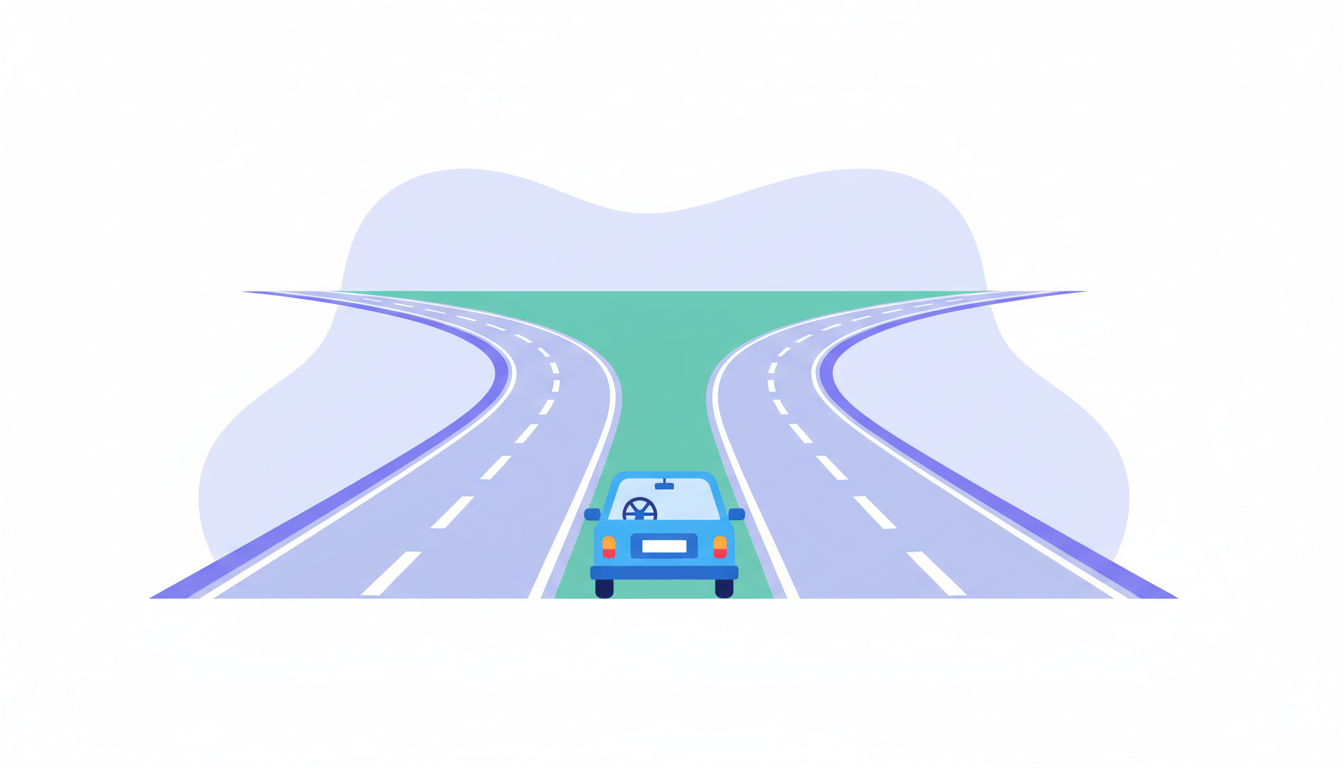
The divided highway sign warns that the road ahead is split by a median or physical barrier. The divided highway ends sign warns that the split is about to stop and two-way traffic is ahead. In the federal Manual on Uniform Traffic Control Devices (MUTCD), these are the Divided Highway sign (W6-1) and the Divided Highway Ends sign (W6-2).
The MUTCD is the federal national standard for these signs, available at mutcd.fhwa.dot.gov. States adopt it, sometimes with changes. This research did not check whether every state's version matches the federal design, so check your own state's DMV handbook for the rules that apply to you.
What the divided highway signs look like
Warning signs in the MUTCD are diamond-shaped with a black legend and border on a yellow background (MUTCD Chapter 2C, p. 147). The standard size for W6-1 and W6-2 is 36 by 36 inches on conventional roads and 48 by 48 inches on expressways and freeways (Table 2C-1, p. 148).
Divided highway begins vs. divided highway ends
People often search for a 'divided highway begins' sign, but the MUTCD has no sign by that name. The W6-1 is the sign placed on the approaches to a section of divided highway. It is used where opposing traffic is separated by a median or other physical barrier, not at an intersection or junction (Sect. 2C.20, p. 170).
The W6-2 is used in advance of the end of a physically divided section, as a warning of two-way traffic ahead (Sect. 2C.21, p. 170). The MUTCD treats W6-2 as guidance, which means it is recommended rather than mandatory.
Older wording: 'Divided Road' and 'Divided Highway Ends'
Older editions of the MUTCD used the wording 'Divided Road,' and a word-message version reading 'DIVIDED HIGHWAY ENDS' on the W6-2a sign (MUTCD 2003 edition, Figure 2C-3). It is not confirmed whether the 11th edition keeps these word-message versions in the same form. If your handbook shows different wording, check with your state's DMV.
Signs people confuse with the divided highway signs
- W6-3 Two-Way Traffic: warns of a transition from a multi-lane divided section to a two-lane, two-way section. It may supplement W6-2 (Sect. 2C.51, p. 189).
- W12-1 Double Arrow: says traffic may pass on either side of an island, obstruction, or gore. It is a separate sign from the divided highway signs (Sect. 2C.23, p. 171).
- W4-2 Lane Ends: warns of a reduction in the number of lanes in the direction of travel, not a median ending (Sect. 2C.47, p. 183).
- Keep Right (R4-7 series): W6-1 must not be used instead of a Keep Right sign at the approach end of a median island (Sect. 2C.20, p. 170).
What three state handbooks say
Three state handbooks cover these signs. Each statement below belongs only to the state named, not to any other state.
- Florida: Florida's handbook lists 'Divided Highway Ahead' and 'Divided Highway Ends' as separate warning signs. It says Divided Highway Ahead means the highway ahead is divided by a median or physical barrier. It says Divided Highway Ends means the divided highway ends 350 to 500 feet ahead, which is Florida's wording only. It also says that after a divided highway ends, the driver will be on a two-way roadway and should keep to the right (Florida Driver License Handbook, p. 49). Separately, the handbook says that on a two-lane highway in Florida, drivers must stay in the right lane unless overtaking and passing (p. 68).
- Texas: Texas's handbook shows a divided highway sign, described as advising that the road ahead has opposing traffic separated by a median island. Its divided highway ends sign warns that the divided highway ends ahead, and that drivers should be careful at the point where two-way traffic begins again. The handbook also describes a separate lane reduction sign that should not be confused with the divided highway sign (Texas Driver Handbook, p. 27).
- California: California's warning-sign page lists 'End Divided Highway' alongside 'Divided Highway' and 'Two Way Traffic' (California Driver Handbook, p. 37). The page gives the sign names only, with no meaning or driver action.
What to do when you see these signs
The general meaning is a warning. Either the road ahead is divided, or the divided section is ending and two-way traffic is coming. Pay attention to traffic on the road ahead. For lane position, follow the rules in your own state's handbook. Florida's handbook gives a keep-right rule after a divided highway ends. This research did not check other states' versions of that rule.
Road sign questions are a common part of the permit test. Try the GetMyPermit practice tests and then check your state's handbook for the wording your test uses.
Sources
Free permit practice test for your state
Ready to check what you know? Take a free 10-question test from your state's driver handbook, with every answer explained. No sign-up needed. See questions and pass marks for every state.
- Alabama
- Alaska
- Arizona
- Arkansas
- California
- Colorado
- Connecticut
- Delaware
- Florida
- Georgia
- Hawaii
- Idaho
- Illinois
- Indiana
- Iowa
- Kansas
- Kentucky
- Louisiana
- Maine
- Maryland
- Massachusetts
- Michigan
- Minnesota
- Mississippi
- Missouri
- Montana
- Nebraska
- Nevada
- New Hampshire
- New Jersey
- New Mexico
- New York
- North Carolina
- North Dakota
- Ohio
- Oklahoma
- Oregon
- Pennsylvania
- Rhode Island
- South Carolina
- South Dakota
- Tennessee
- Texas
- Utah
- Vermont
- Virginia
- Washington
- West Virginia
- Wisconsin
- Wyoming