

Driving Tips for Beginners: What New Drivers Should Know
Driving tips for beginners from official handbooks: set up your seat and mirrors, keep 3 seconds of space, scan ahead and put the phone away.
Bianca Galvan
Product & Content at GetMyPermit
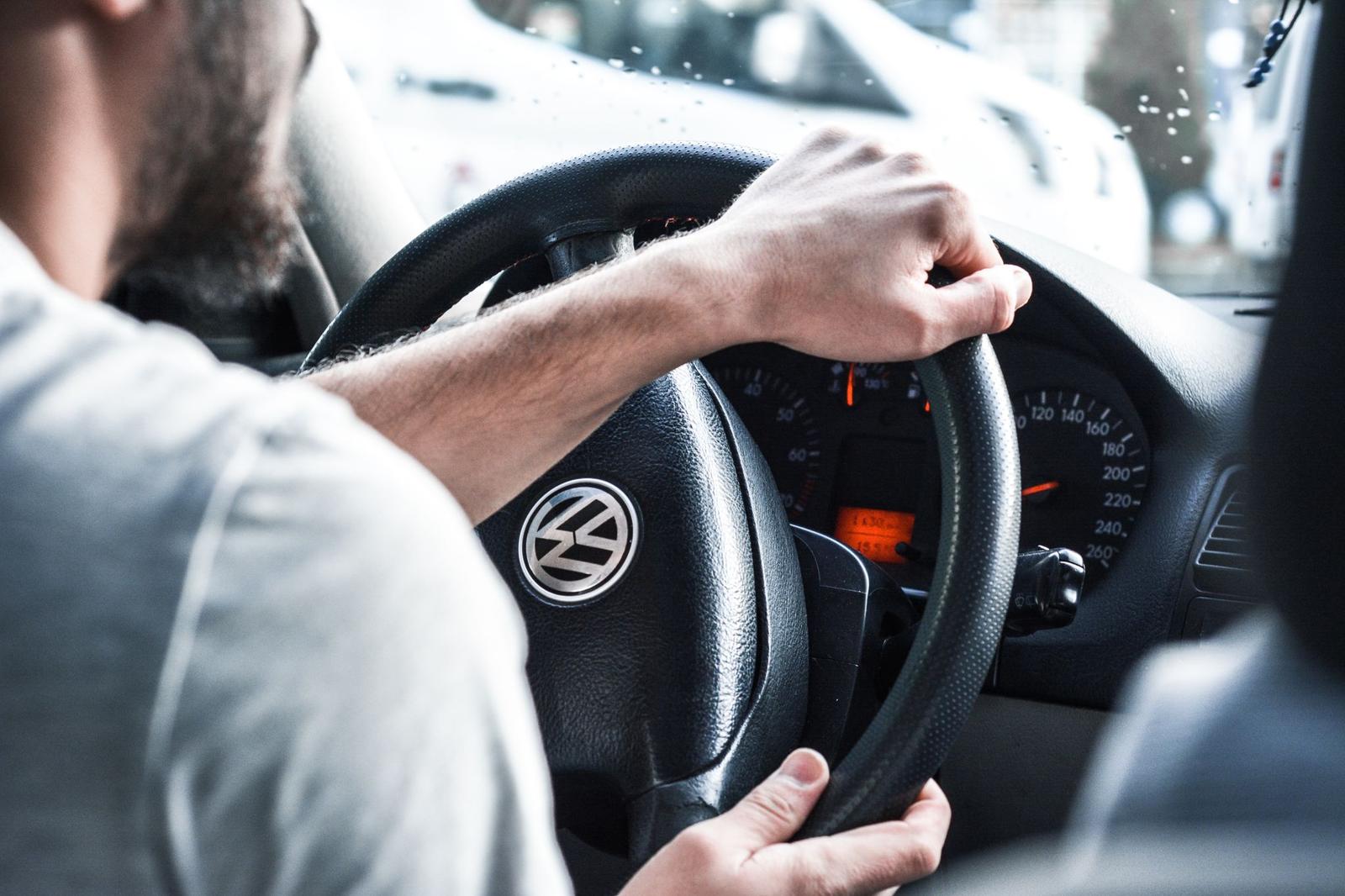
The most useful driving tips for beginners are simple habits: set up your seat and mirrors before you move, buckle up, keep at least three seconds of space behind the car ahead, look far down the road, put your phone away and slow down for rain, fog and darkness. Start in quiet places like empty parking lots and only move to busier roads once the basics feel automatic.
These habits matter because new drivers crash more. According to the CDC, drivers ages 16 to 19 have a fatal crash rate almost three times that of drivers 20 and older, per mile driven.
The tips below come from state driver handbooks and the CDC. Rules on phones and passengers vary by state, so check your own state's handbook too.
Why are new drivers more likely to crash?
The CDC lists several risk factors for teen drivers. A few stand out for anyone who is just starting:
- Inexperience. 16-year-old drivers have a crash rate per mile about 1.5 times that of 18 and 19-year-olds.
- Night driving. The fatal crash rate at night for drivers ages 16 to 19 is about 3 times that of adults ages 30 to 59, per mile driven.
- No seat belt. In 2020, 56% of teen drivers and passengers (ages 16 to 19) killed in crashes were not wearing a seat belt.
- Speeding. In 2020, 35% of male drivers and 18% of female drivers ages 15 to 20 involved in fatal crashes were speeding.
- Passengers. Crash risk for unsupervised teen drivers rises with each additional teen or young adult passenger.
Most of these are habits you control from day one. Adults learning for the first time face the same basics; our guide on how to get your license at 18 or older covers the adult side of the process.
How should you set up your seat and mirrors before driving?
Do this every time, before the car moves. The driver's manual from Pennsylvania lays out a clear order:
- Seat first. You must be able to easily reach the pedals and other controls and have a clear view out the windshield.
- Head restraint. Adjust it so the top is at least as high as the top of your ears.
- Mirrors after the seat. Set the rearview mirror so you can see the traffic directly behind you. Set each side mirror so that when you lean left or right, you can just barely see the side of your own car.
- Seat belt. Fasten both the lap and shoulder belt on every trip.
The California Driver's Handbook adds two details:
- Wear the shoulder strap across your chest and keep the lap belt low and snug across your hips.
- Sit at least 10 inches from the airbag cover, as long as you can still fully control the car.
Why the seat belt matters so much: the CDC says seat belts reduce serious crash-related injuries and deaths by about half. Pennsylvania's manual calls wearing one "the single most effective thing you can do" to reduce your risk of death or injury.
Where should you hold the steering wheel?
The California DMV handbook says to start with your hands at 9 and 3 o'clock or 8 and 4 o'clock for push/pull (hand-to-hand) steering, and to keep them in those positions even when turning. Hand-over-hand steering, which starts at 8 and 4, is for low-speed turns, parking or recovering from a skid.
For step-by-step help with smooth stops and turns, see how to brake smoothly.
How much following distance should a beginner keep?
Keep at least three seconds of space between you and the car ahead, and more when conditions are bad. California's handbook uses the three-second rule. New York's manual explains a simple way to count it:
- Pick a fixed object near or above the road, like a sign, tree or overpass.
- When the car ahead passes it, count "one thousand one, one thousand two."
- If you reach the object before you finish counting, you're too close.
New York's manual uses two seconds as the minimum but says to count at least three or four seconds in bad weather or when following large trucks. Since three seconds is the safer of the two, it's a good default while you're learning.
California's handbook says to increase your following distance when:
- Someone is tailgating you
- You're following a motorcycle on metal surfaces (like bridge gratings or railroad tracks) or gravel
- Visibility is poor or roads are slippery
- A car merges in too closely in front of you (take your foot off the gas)
New York's manual notes that four of every 10 crashes involve rear-end collisions, usually from following too closely. It also says to leave "escape" room to your left and right, so you have somewhere to go if you need to change lanes or pull over quickly.
If someone is tailgating you, New York's manual says to change lanes if you can, or slow down and pull off to let them pass.
Where should you look while driving?
Look far ahead, not just at the car in front of you. California's handbook says to scan the road at least 10 seconds ahead of your vehicle and to keep your eyes moving. New York's manual says to check your mirrors every few seconds.
Mirrors don't show everything. Before you change lanes, turn, merge, back up, leave a parking space, pull away from the curb or open your door, California's handbook says to look over your shoulder through the side window. Turn only your head, not your body or the steering wheel, so the car doesn't drift.
California's handbook also says not to sit in another driver's blind spot or drive right alongside other cars for long.
Merging onto a highway is one of the hardest places to put all this together. Our guide on merging onto a highway walks through it step by step.
How fast should you drive as a beginner?
Drive at a speed you can handle for the conditions, which is often below the posted limit. California's handbook says you may never drive faster than is safe for the current road conditions, and that you must drive slower in heavy traffic or bad weather. (California calls this the Basic Speed Law, which we explain in Basic Speed Law: What It Means in California.)
A few specific limits from California's handbook show how much speed should drop in certain places:
- School zones: 25 mph within 500 feet of a school while children are outside or crossing the street
- Blind intersections: 15 mph
- Wet roads: reduce your speed by 5 to 10 mph
Other states set their own limits, so check your state's handbook for the exact numbers.
Should you have your phone out while driving?
No. Put it away before you start the car. The CDC describes three types of distraction, and a phone can cause all three:
- Visual: taking your eyes off the road
- Manual: taking your hands off the wheel
- Cognitive: taking your mind off driving
The CDC, citing NHTSA, reports that in 2019 over 3,100 people were killed and about 424,000 were injured in crashes involving a distracted driver.
Many states have stricter phone rules for young drivers. Two examples:
- California: it's against the law for a minor to use a cell phone or wireless device while driving, even to answer calls. The only exception is calling for emergency help. The handbook also says not to send or read texts or emails while driving, and that a mounted phone can't block your view of the road.
- New York: probationary and junior drivers who use a hand-held phone or text face a 120-day suspension for a first conviction.
Phones aren't the only distraction. California's handbook also lists navigation systems, pets, changing music and applying makeup, so set your music and directions before you pull out.
When should a beginner start driving at night or in bad weather?
After you're comfortable in daylight and good weather. California's teen driver page says it's best not to start driving at night until you've mastered your driving skills during daylight hours. Many states also limit when new drivers can be on the road at night, which we cover in Can You Drive at Night With a Learner's Permit?
When you do drive at night, California's handbook says:
- Use high beams on open country roads or dark city streets, and make sure you can stop within the distance your headlights light up.
- Dim your high beams for oncoming cars.
- If oncoming headlights are bright, look toward the right edge of your lane instead of into the glare.
- Slow down after leaving a brightly lit area, while your eyes adjust.
For rain, fog and snow, California's handbook says:
- Slow down at the first sign of rain, drizzle or snow on the road.
- Use low-beam headlights when it's raining. Never drive with only your parking lights.
- In fog, use low beams. High beams reflect back and cause glare.
- If you can't see farther than 100 feet, it isn't safe to drive faster than 30 mph.
- On packed snow, cut your speed in half. On ice, go no faster than 5 mph.
- Increase your following distance and make sure you can stop within the space you can see ahead.
Tiredness is a risk too. New York's manual lists warning signs like drifting between lanes and not remembering the last few miles, and recommends a stop every 100 miles or two hours on long trips.
Where should you practice when you're just starting?
Start somewhere with little or no traffic and build up from there. California's teen driver page recommends:
- Large, open parking lots for practicing turns
- Large, open parking lots for parallel parking
- Wide residential streets with little to no traffic for U-turns
Once the controls feel automatic in a quiet place, build up to busier roads, and save night driving and bad weather until you're comfortable in daylight. If a parent or another adult is teaching you, our guide on how to teach someone to drive is written for them.
Most states also require a set number of supervised practice hours before you can take the road test. In California, for example, teens need 50 hours of supervised practice, including 10 hours at night. A driving log makes those hours easy to track. If you're wondering how long all of this takes, see How Long Does It Take to Learn to Drive?
What about passengers?
Keep passengers to a minimum while you're new, especially other teens. The CDC says crash risk for unsupervised teen drivers rises with each additional teen or young adult passenger. Its recommended best practice for newly licensed teens includes no teen or young adult passengers and limits on driving from 9 or 10 pm until 5 am.
Your state's graduated license rules may already set these limits. Our guide to graduated driver licenses explains how the stages work. Some families also write the rules down in a parent-teen driving contract, which the CDC suggests as a way for parents and teens to agree on safe driving practices.
What if driving makes you nervous?
Feeling nervous at first is common. Practicing in low-risk places first, keeping extra following distance and driving at a speed you can handle all help. For more on managing nerves, both on the road and on test day, read How to Overcome Driving Anxiety.
Knowing the rules well also takes a lot of stress out of driving. Before you get behind the wheel, you'll need to pass your state's knowledge test, and you can use our practice tests to study for your permit test.
Sources
- Risk Factors for Teen Drivers (CDC)
- Reducing Risk for Teen Drivers (CDC)
- Distracted Driving (CDC)
- Chapter 3: Choosing Safety First, Pennsylvania Driver's Manual (Pennsylvania Driver and Vehicle Services)
- Chapter 8: Defensive Driving, Driver's Manual (New York DMV)
- Section 5: An Introduction to Driving, California Driver's Handbook (California DMV)
- Section 7: Laws and Rules of the Road (Continued), California Driver's Handbook (California DMV)
- Section 8: Safe Driving, California Driver's Handbook (California DMV)
- Section 8: Safe Driving (Continued), California Driver's Handbook (California DMV)
- Section 8: Safe Driving (Continued), California Driver's Handbook (California DMV)
- Teen Driver Tips (California DMV)
Free permit practice test for your state
Ready to check what you know? Take a free 10-question test from your state's driver handbook, with every answer explained. No sign-up needed. See questions and pass marks for every state.
- Alabama
- Alaska
- Arizona
- Arkansas
- California
- Colorado
- Connecticut
- Delaware
- Florida
- Georgia
- Hawaii
- Idaho
- Illinois
- Indiana
- Iowa
- Kansas
- Kentucky
- Louisiana
- Maine
- Maryland
- Massachusetts
- Michigan
- Minnesota
- Mississippi
- Missouri
- Montana
- Nebraska
- Nevada
- New Hampshire
- New Jersey
- New Mexico
- New York
- North Carolina
- North Dakota
- Ohio
- Oklahoma
- Oregon
- Pennsylvania
- Rhode Island
- South Carolina
- South Dakota
- Tennessee
- Texas
- Utah
- Vermont
- Virginia
- Washington
- West Virginia
- Wisconsin
- Wyoming